

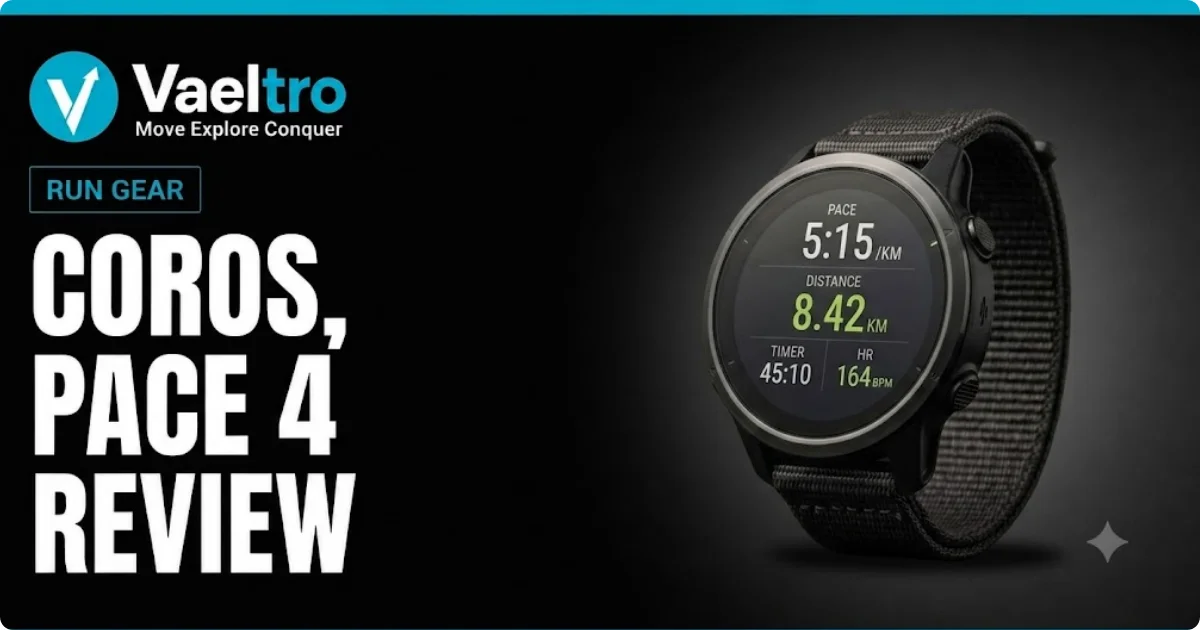
For years, Garmin owned the serious runner market almost by default. You wanted reliable GPS, training data you could actually trust, and a watch that would last through a full training block without dying on you — and Garmin was the answer. Coros changed that conversation when it launched the Pace 2, and the Pace 3 pushed things even further. Now the Pace 4 is here, and the question runners are asking is simple: has Coros finally built the watch that closes the gap for good?
That “Garmin killer” label gets attached to a lot of products that don’t earn it. This review is about whether the Pace 4 genuinely belongs in that conversation or whether it’s marketing energy dressed up as a running watch. We’ll work through the real-world performance, the honest comparisons against the Forerunner 165 and 265, and whether Pace 3 owners have any real reason to upgrade.
Quick Answer
The Coros Pace 4 is one of the best value running watches available in 2024 at its price point. It delivers accurate GPS, genuinely impressive battery life, and a serious training feature set that competes with Garmin watches costing significantly more. It isn’t perfect heart rate tracking has limitations, and the software ecosystem is narrower than Garmin’s but for dedicated runners who want performance data without paying flagship prices, it delivers.
What Is the Coros Pace 4?
The Coros Pace 4 is a GPS running watch designed for serious recreational and competitive runners. It sits at the performance tier of Coros’s lineup, positioned below the Apex and Vertix but above the basic entry-level options. The target runner is someone who trains consistently, cares about data quality, and wants a watch capable of handling everything from easy recovery miles to race day.
Coros launched the Pace 4 in 2024 as a direct successor to the Pace 3, refining the formula rather than rebuilding it. The watch runs on Coros’s own software platform and pairs with the Coros app on iOS and Android.
Coros Pace 4 Design and Build Quality
The Pace 4 is light. Seriously light. The nylon strap version weighs around 30 grams, which is competitive with almost anything at this price and lighter than most Garmin equivalents. You notice the absence of weight on long runs and during sleep tracking, where a heavy watch becomes genuinely irritating.
The casing is polycarbonate with a titanium alloy bezel on some models, giving it a cleaner look than the plastic-dominant build of the Pace 3. It feels like a considered upgrade rather than a cosmetic one the watch doesn’t feel fragile, but it also doesn’t feel like it’s trying to be a fashion accessory. This is a tool, and the design reflects that.
The physical dial control on the right side of the case is a signature Coros design choice. Instead of a full touchscreen operation, you navigate using a combination of the dial and side button. It works cleanly and responds consistently, which matters when you’re mid-run with sweaty hands or wearing gloves in cold weather.
Display and Screen
The Pace 4 uses an AMOLED display, which is a meaningful upgrade over the transflective MIP screen on the Pace 3. Colors are richer, contrast is better, and the watch is significantly easier to read in low-light conditions. Outdoors in bright sun, the display holds up well, though in direct harsh sunlight some runners may find MIP screens marginally easier at a glance.
The screen is 1.3 inches. It’s large enough to show multiple data fields clearly without requiring a squint at running pace, but it won’t feel overwhelming on a smaller wrist.
Strap and Wrist Comfort
The nylon band on the standard version is breathable and comfortable for long training blocks. It doesn’t trap heat the way silicone straps sometimes do in summer. The silicone option is available for those who prefer it, but the nylon is the better everyday choice for most runners.
The watch sits low on the wrist and doesn’t bounce during faster efforts, which matters more than it sounds when you’re doing 400-meter repeats.
How Does It Perform on the Run?
Hardware specs look good on paper. What actually matters is how the watch behaves when you’re 18 miles into a long run and relying on it.
GPS Accuracy
The Pace 4 uses dual-frequency GPS L1 and L5 combined with multi-band GNSS. In practice, this translates to accurate tracking in open areas and solid performance in more challenging environments like city blocks with tall buildings or trail runs through dense tree cover. Distance readings have tested consistently close to measured routes, and the watch locks onto satellite signal quickly at the start of a run.
It isn’t flawless in the tightest urban canyons, but nothing is. For most runners in most conditions, the GPS performance is genuinely reliable.
Heart Rate Accuracy
This is where an honest review has to be careful. The optical heart rate sensor on the Pace 4 performs well during steady-state runs it tracks accurately at easy and moderate intensities. During high-intensity efforts, intervals, or fast tempo work, the sensor can lag or briefly misread, which is a known limitation of optical HR sensors across most brands at this price.
If precise heart rate data during hard efforts is critical to your training, pairing the Pace 4 with a chest strap is the right move. The watch supports ANT+ and Bluetooth HR monitors. For runners who train by feel or use HR primarily for zone 1 and 2 work, the built-in sensor is adequate.
Pace and Distance Tracking
Real-time pace display is responsive and consistent. Cadence, stride length, and ground contact time are all tracked and presented clearly during and after runs. The data feels usable rather than decorative there’s a difference, and the Pace 4 falls on the right side of it.
Battery Life
The Pace 4 is exceptional here. Coros quotes around 38 hours in GPS mode with the AMOLED display active. In practice, real-world battery life lands somewhere close to that depending on settings and GPS mode.
For ultramarathon runners or anyone doing multi-day events, the watch supports extended battery modes that stretch life significantly further, though with reduced tracking frequency. For standard marathon training including long runs of 20+ miles and daily tracking most runners will charge the Pace 4 roughly once a week.
This is one of the most meaningful areas where the Pace 4 pulls ahead of comparable Garmin options. The Forerunner 265 offers around 24 hours of GPS battery life. That’s still functional for most use cases, but the Pace 4’s advantage is real and practical for runners who push long distances.
Coros Pace 4 Features Breakdown
Training Metrics and Load Analysis
The Pace 4 provides a training load system that measures effort over time and flags when you’re overreaching or undertraining. It tracks training effect both aerobic and anaerobic and gives a recovery time recommendation after hard sessions. The data integrates with Coros’s EvoLab feature, which monitors long-term fitness development including VO2 max estimation and race time predictions.
These metrics are genuinely useful for runners who pay attention to periodization, and the presentation in the app is clean enough that the numbers don’t require a degree in exercise physiology to interpret.
Navigation and Maps
The Pace 4 supports breadcrumb navigation you can follow a route loaded from the app or a GPX file, and the watch will show your path and alert you if you deviate from it. It does not offer full topographic map display, which is a feature reserved for Coros’s higher-tier Apex and Vertix models.
For trail runners who rely on detailed map navigation mid-run, this is a limitation worth knowing before purchasing. For road runners or trail runners who load a planned route and follow it, breadcrumb navigation is sufficient.
Sleep and Recovery Tracking
Sleep tracking is included and measures duration along with some sleep stage data. The recovery recommendations pull from both sleep data and training load. The tracking is functional rather than deeply sophisticated runners who want granular sleep science data may find Garmin’s Body Battery or Whoop’s system more detailed. For most runners, the Pace 4’s sleep tracking provides enough information to inform recovery decisions.
Triathlon and Multisport Mode
The Pace 4 includes triathlon mode with automatic transition detection between swim, bike, and run segments. It tracks open water swimming and pool swimming, cycling with power meter support, and running in a single continuous activity with split data across disciplines.
For triathletes looking at an entry-to-mid-tier option, the Pace 4 covers the functional requirements well. It isn’t as deep as dedicated triathlon-focused watches, but it handles the core workflow without issue.
Coros Pace 4 vs Pace 3: Is the Upgrade Worth It?
| Feature | Coros Pace 4 | Coros Pace 3 |
|---|---|---|
| Display | AMOLED | MIP (Transflective) |
| Bezel Material | Titanium Alloy | Polycarbonate |
| GPS System | Dual-Frequency (L1 + L5) | Dual-Frequency GNSS |
| Weight (Nylon) | ~30g | ~30g |
| Low-Light Readability | Excellent | Moderate |
| Upgrade Priority | New buyers or display-focused runners | Still strong for existing owners |
The Pace 3 was already a strong watch, which makes this comparison honest rather than straightforward. The main differences are real but targeted.
The AMOLED display on the Pace 4 is a genuine step up from the MIP screen on the Pace 3. If you run in low-light conditions frequently early morning, evening, or winter you’ll notice the difference immediately and appreciate it daily.
The build feels slightly more refined on the Pace 4, with the titanium alloy bezel improving durability and perceived quality. GPS performance is similar between both watches, using dual-frequency GNSS on both generations.
The upgrade is worth it if you care about the display improvement or are purchasing new. If you own a Pace 3 and it’s working well, the case for upgrading is present but not urgent. The core training functionality is strong on both.
Coros Pace 4 vs Garmin Forerunner 165
| Feature | Coros Pace 4 | Garmin Forerunner 165 |
|---|---|---|
| Display | AMOLED | AMOLED |
| GPS Battery Life | ~38 hours | ~19 hours |
| GPS System | Dual-Frequency (L1 + L5) | Multi-Band GPS |
| Training Analytics | EvoLab, Training Load | Body Battery, Training Status |
| Third-Party App Store | No | Yes (Connect IQ) |
| Best For | Battery life, GPS performance | Garmin ecosystem users |
The Forerunner 165 is Garmin’s entry-performance watch and sits in a similar price bracket to the Pace 4. The comparison is direct and relevant.
The Pace 4 wins clearly on battery life roughly 38 hours GPS versus approximately 19 hours on the FR 165. For marathon runners and anyone doing long training days, this is a practical difference.
The Forerunner 165 offers Garmin’s broader software ecosystem, including Garmin Connect, Connect IQ for third-party apps, and tighter integration with other Garmin devices. If you’re already in the Garmin ecosystem with a bike computer, scale, or other devices, the FR 165 slots in more cleanly.
Training metrics are competitive between both. Garmin’s Body Battery and sleep analytics are arguably more refined. Coros’s EvoLab and training load tools are on par for most runners’ purposes.
The Pace 4 is the stronger choice for runners who prioritize battery life and GPS performance. The FR 165 suits runners who value ecosystem depth and Garmin’s software maturity.
Coros Pace 4 vs Garmin Forerunner 265
| Feature | Coros Pace 4 | Garmin Forerunner 265 |
|---|---|---|
| Display | AMOLED | AMOLED |
| GPS Battery Life | ~38 hours | ~24 hours |
| HRV Tracking | Basic | More refined |
| Third-Party Apps | No | Yes (Connect IQ) |
| Navigation | Breadcrumb only | Breadcrumb + stronger map support |
| Price Position | Lower | Higher |
| Best For | Value-focused runners | Ecosystem depth, software polish |
This comparison pulls in a different direction because the FR 265 typically sits at a higher price point than the Pace 4. That price gap is part of what makes the Coros compelling.
The Forerunner 265 offers a more established training status system, more refined HRV tracking, and a deeper library of third-party apps. It also has a bright AMOLED display that matches the Pace 4’s visual quality. Garmin’s navigation experience and map support are stronger at this tier.
The Pace 4 counters with better battery life the FR 265 offers around 24 hours GPS and a lower purchase price. For a runner who wants Forerunner 265-level training data without paying Forerunner 265 prices, the Pace 4 makes a genuinely strong case.
If budget is not the primary factor, the FR 265 offers more software polish and ecosystem depth. If value for money matters and it does for most runners the Pace 4 closes the gap enough to make the price difference hard to justify.
Coros App and Software Experience
The Coros app is clean and functional. Training data syncs reliably after runs, and the presentation of EvoLab metrics, training load, and recovery data is organized without feeling cluttered. Route planning, workout creation, and firmware updates all work through the app without friction.
The honest limitation is ecosystem breadth. Garmin Connect has a larger community, more third-party app integrations, and a more established data export network. Coros integrates with Strava, TrainingPeaks, and Apple Health, which covers the majority of what most runners need. But if you rely on niche training tools or want a deeper app library, Coros’s platform is narrower.
Firmware updates from Coros have historically been responsive to user feedback. The company has a track record of improving watches after launch rather than abandoning them, which matters for long-term ownership.
Who Should Buy the Coros Pace 4?
The Pace 4 is built for runners who train seriously and want their data to reflect that. It suits road runners, trail runners, and multisport athletes who want capable GPS, a long battery life, and honest training analysis without paying for features they’ll never use.
It’s particularly strong for marathon and ultramarathon runners where battery life across long training days is a real operational concern. Triathletes looking for a functional, affordable multisport option will find it covers their needs.
It’s a less natural fit for runners who are deeply embedded in the Garmin ecosystem, or those who rely on third-party app integrations that Coros doesn’t currently support. Runners who need full topographic maps mid-activity should look at higher-tier options.
Final Verdict
The Coros Pace 4 earns the “Garmin killer” framing more convincingly than most watches that get that label. It doesn’t beat Garmin at everything the software ecosystem is narrower, and Garmin’s training analytics have a maturity edge in some areas but it matches or exceeds the competition on the metrics that matter most to runners: GPS accuracy, battery life, training data quality, and value for money.
At its price, it competes with the Forerunner 265 on features while undercutting it on cost, and it clearly outperforms the Forerunner 165 on battery life. For a runner starting fresh or looking to replace an aging watch, the Pace 4 is one of the most rational purchases in the category right now.
If you run consistently, care about your training data, and don’t want to pay flagship prices to get flagship-level performance, the Coros Pace 4 delivers exactly what it promises.
