

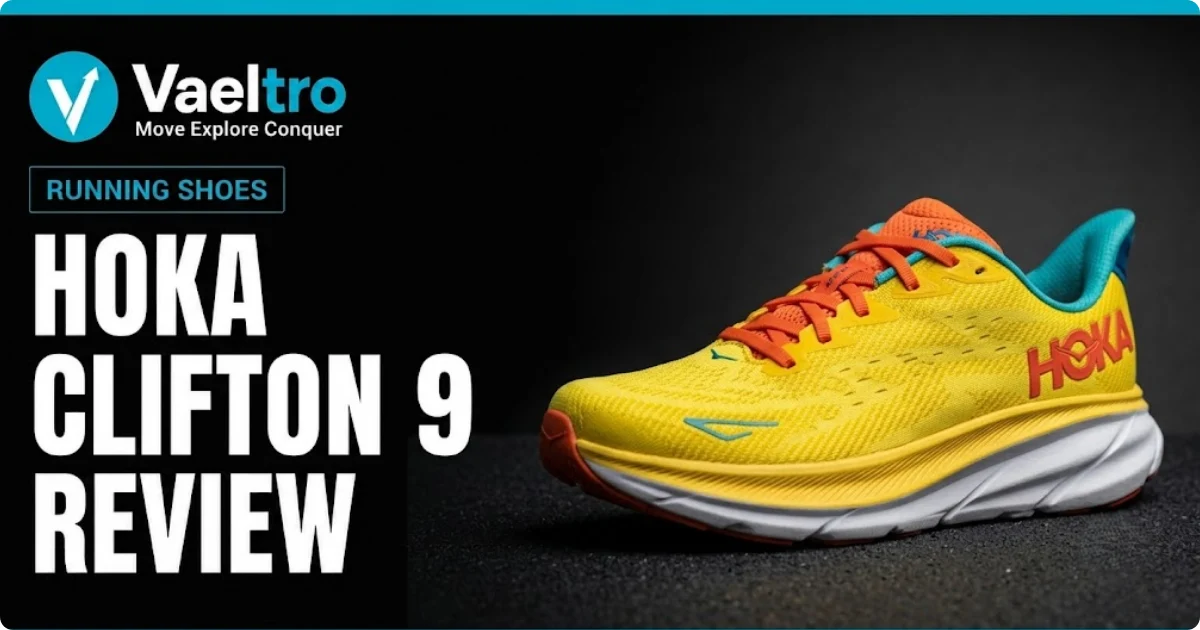
The HOKA Clifton has been one of the most recognizable names in running for over a decade. Not because it invented max cushioning, but because it made max cushioning approachable light, smooth, and wearable every single day. The Clifton 9 carries that reputation forward with a few meaningful upgrades, but it also steps into a more competitive market than any of its predecessors faced.
After logging 300-plus miles across easy days, long runs, and recovery jogs, this review covers everything a runner actually needs to know: how it rides, who it fits, and whether it still earns a spot in your rotation now that the Clifton 10 has arrived.
Quick Answer
The HOKA Clifton 9 is a lightweight max-cushion daily trainer built for easy runs, recovery miles, and long-distance comfort. It rides soft but not mushy, fits narrow through the toe box in standard width, and suits neutral to mild overpronators. At its current sale price, it offers exceptional value but runners with wide feet, flat feet needing structured support, or those chasing speed should look elsewhere.
What Makes the Clifton 9 Different from the Clifton 8
The biggest change in the Clifton 9 is the midsole. HOKA replaced the previous EVA compound with a new compression-molded EVA (CMEVA) foam that is noticeably softer and more energetic than what was in the Clifton 8. Stack height increased by 3mm up to 29mm in the heel and 24mm in the forefoot under the standard measurement convention HOKA uses while the shoe actually got lighter at the same time.
The upper was also simplified. HOKA removed overlays and hotmelt bonding from the Clifton 8, replacing them with a cleaner engineered knit that wraps the foot more naturally. A plusher heel collar and a gusseted tongue improve lockdown without adding stiffness. The outsole received a durability upgrade too, with more Durabrasion rubber coverage in the high-wear zones.
None of these are revolution-level changes. But together they move the Clifton 9 meaningfully forward — softer landing, livelier toe-off, better upper security, and more protection underfoot on longer efforts.
Specs at a Glance
| Spec | Men’s | Women’s |
|---|---|---|
| Weight | 8.9 oz (252g) — US M9 | 7.5 oz (213g) — US W8 |
| Heel Stack Height | 29mm | 28mm |
| Forefoot Stack Height | 24mm | 23mm |
| Heel-to-Toe Drop | 5mm | 5mm |
| Midsole Foam | Compression-Molded EVA (CMEVA) | Compression-Molded EVA (CMEVA) |
| Outsole | Durabrasion Rubber (partial coverage) | Durabrasion Rubber (partial coverage) |
| Upper | Engineered Knit | Engineered Knit |
| Widths Available | B (Regular), 2E (Wide) | B (Regular), D (Wide) |
| Geometry | Early-Stage MetaRocker | Early-Stage MetaRocker |
| Best For | Easy runs, long runs, recovery, walking | Easy runs, long runs, recovery, walking |
| Retail Price (Original) | $145–$150 | $145–$150 |
How the Clifton 9 Actually Feels on the Run
Easy and Recovery Runs
This is where the Clifton 9 earns its reputation. The CMEVA midsole absorbs impact well, the MetaRocker geometry rolls the foot forward naturally, and the wide midsole platform provides a stable base without any medial posting or aggressive guidance. On tired legs, it feels genuinely forgiving — the kind of shoe that makes it easier to keep easy days easy.
The ride sits in the middle of the cushioning spectrum. It is not as pillowy as the Bondi 8, and not as firm as the Brooks Ghost or Saucony Ride. For runners who find ultra-soft shoes unstable and firm shoes punishing, the Clifton 9 tends to land exactly in the right place.
Long Runs
The Clifton 9 handles distance well up to the 14-to-16 mile range for most runners. The stack height provides enough protection to take the edge off cumulative road impact, and the rocker keeps transitions smooth even when stride form starts to break down late in a run.
One honest caveat: the CMEVA foam does lose some of its initial pop as mileage accumulates on the shoe. This is normal for EVA-based foams, and it does not affect the shoe’s protective ability in the short term — but runners who prioritize that lively feel should be aware it mellows after the first 100 miles or so.
Tempo and Faster Efforts
The Clifton 9 can handle the occasional tempo run or stride, but it is not built for speed. The MetaRocker assists with rollover efficiency, and the toe-off feels reasonably responsive for a max-cushion shoe. However, the midsole does not produce the snappy energy return of foams like PEBA or Saucony’s Pwrrun+. It will not slow you down noticeably on a faster easy day, but for structured intervals or race-specific workouts, a more responsive trainer is the better choice.
Fit and Sizing: What to Know Before You Buy
Standard Width
The Clifton 9 fits true to size in length. The heel and midfoot feel secure, and the gusseted tongue eliminates the shifting that was a complaint in earlier Clifton versions. The main fit caveat is the toe box. In standard width, the Clifton 9 tapers aggressively toward the front, which causes pressure on the pinky toe and big toe joint for runners with medium-to-wide feet — especially on runs over 60 minutes when feet naturally swell.
Runners with narrow to medium-narrow feet will find the standard width comfortable and well-fitted. Runners with medium or wider feet should try the wide version before committing.
Wide Width
HOKA offers the Clifton 9 in 2E (wide) for men and D (wide) for women. The wide version provides meaningful additional room through the forefoot and midfoot, and it is genuinely worth sizing into if your feet run medium-wide or wider. It remains the same weight and ride character as the standard — only the fit volume changes.
Women’s Fit
The women’s Clifton 9 is built on a women’s-specific last rather than a scaled-down men’s version. Women’s models typically run slightly narrower through the heel and midfoot, which improves lockdown for runners with lower-volume feet. Stack height specs are marginally different in the women’s version (29mm heel / 24mm forefoot in women’s vs. 29mm / 24mm in men’s at standard sizing — verify current production specs on HOKA’s site as colorway runs can vary).
Women who have previously found HOKA shoes too narrow should strongly consider the wide women’s version, or compare against the Bondi 8, which offers a slightly more generous forefoot in its standard width.
Flat Feet and High Arches
The Clifton 9 is a neutral shoe. It does not include a medial post, guide rail, or any structured overpronation control. Runners with mild to moderate flat feet who have trained successfully in neutral shoes will generally do well in it — the wide platform provides passive stability, and the rocker reduces the demand on the arch during push-off.
Runners with severe flat feet, significant overpronation, or a history of posterior tibial tendon issues should consider a stability shoe such as the HOKA Arahi or Brooks Adrenaline GTS instead. The Clifton 9 will not provide adequate medial support for that population.
Runners with high arches tend to do well in the Clifton 9 because the soft, even cushioning distributes impact load across a high-arched foot more comfortably than firm, flat shoes.
Is the Clifton 9 Good for Walking?
Yes and this is one of the Clifton’s underrated strengths. The MetaRocker geometry that assists running transitions also makes extended walking noticeably more comfortable. The cushioning reduces fatigue on hard surfaces, and the shoe’s lightweight build (under 9 oz in men’s) means it does not feel heavy even on longer outings on foot.
Healthcare workers, retail staff, and anyone spending long hours on their feet have gravitated toward the Clifton line for years, and the 9 continues to serve that use case well. If walking is the primary activity, the fit caveat around the narrow toe box still applies — plan for some toe splay on extended sessions and try the wide version if standard feels snug at the front.
HOKA Clifton 9 vs HOKA Bondi 8: Which One Is Right for You?
| Feature | HOKA Clifton 9 | HOKA Bondi 8 |
|---|---|---|
| Weight (Men’s) | 8.9 oz | 10.8 oz |
| Heel Stack Height | 29mm | 40mm |
| Forefoot Stack Height | 24mm | 35mm |
| Heel-to-Toe Drop | 5mm | 4mm |
| Midsole Foam | CMEVA | CMEVA |
| Cushioning Level | High | Maximum |
| Ride Feel | Soft, smooth, balanced | Very soft, plush, pillowy |
| Versatility | Easy runs, long runs, tempo, walking | Easy runs, recovery, walking |
| Toe Box | Narrow in standard width | Slightly more generous |
| Best For | Everyday training across all easy paces | Maximum cushion, recovery, post-race |
| Original Retail Price | $145–$150 | $165 |
The Bondi 8 is HOKA’s maximum cushioning offering. It has more stack height, a wider midsole platform, and a heavier overall build. The Clifton 9 uses the same cushioning philosophy but packages it in a lighter, more versatile shoe.
Choose the Clifton 9 if you want a daily trainer that works across easy miles, longer runs, and occasional faster efforts without feeling like too much shoe. Choose the Bondi 8 if cushioning volume is the single priority — for recovery days, post-race walking, or runners whose joints demand the maximum possible impact protection.
For most runners doing general training, the Clifton 9 is the more practical choice. The Bondi 8 is worth considering if you are coming off injury, running exclusively at easy paces, or regularly covering distances of 18 miles or more.
Why Is the Clifton 9 Discontinued And Should That Stop You from Buying It?
The Clifton 9 was discontinued because the Clifton 10 replaced it as HOKA’s current lineup model. This is normal product cycling — not an indication of quality problems or a recall. The Clifton 10 introduces updates to the midsole foam and upper construction, but the core ride character of the Clifton line remains consistent across versions.
What discontinuation actually means for buyers: the Clifton 9 is now widely available at significantly reduced prices. Retailers and HOKA’s own site frequently list it in the $90–$120 range, down from its original $145–$150 retail. For a shoe that originally competed with the Brooks Ghost and Saucony Ride at full price, those sale prices represent excellent value.
There is no performance reason to avoid the Clifton 9 because it has been superseded. If the Clifton 10’s updates genuinely matter to you — primarily a softer midsole compound and refined upper — pay the full price for the newer model. If you want proven daily trainer performance at a reduced cost, the Clifton 9 at sale price is a straightforward buy.
How Many Miles Can You Expect from the Clifton 9?
Most runners can expect 300 to 450 miles from a pair of Clifton 9s. The Durabrasion rubber outsole holds up well in the high-impact zones, but the CMEVA midsole foam will gradually compact and lose cushioning feel before the outsole shows significant wear.
Several factors influence where your pair lands in that range. Heavier runners compress the foam faster and tend toward the lower end. Runners who rotate the Clifton 9 with another shoe rather than wearing it daily — extend its useful life by giving the foam time to decompress between sessions. Road surface matters too: smooth pavement is far kinder to the outsole rubber than rough concrete or chip-seal.
The practical sign to retire the Clifton 9 is not the mileage number but how the shoe feels. When the cushioning that once absorbed impact starts transmitting it instead when the ride feels flat or your legs feel more fatigued than usual after familiar runs it is time. That transition usually happens before the outsole looks visually worn.
Who Should Buy the Clifton 9 (And Who Should Skip It)
Buy the Clifton 9 if you:
- Want a lightweight max-cushion daily trainer for easy and long runs
- Have narrow to medium-narrow feet and prefer a secure, snug fit
- Are a heel striker looking for smooth, forgiving transitions
- Need a versatile shoe that works for both running and extended walking
- Are buying at sale price and want proven daily trainer performance at reduced cost
- Are a beginner runner looking for one shoe that covers all training paces
Skip the Clifton 9 if you:
- Have wide or medium-wide feet and cannot access the wide version
- Need structured overpronation control or medial support
- Run primarily at tempo pace or faster and want snappy energy return
- Prefer a firm, road-feel midsole over a soft, cushioned one
- Are a heavier runner who finds EVA foam compresses too quickly
- Want the most current HOKA technology (look at the Clifton 10 instead)
Final Verdict
The HOKA Clifton 9 remains one of the most capable daily trainers in its class, even with the Clifton 10 now on shelves. It does exactly what a high-mileage daily trainer should: it protects your legs on easy days, holds up through long runs, and stays light enough that it never feels like an obstacle.
Its limits are worth knowing. The narrow toe box is a genuine issue for medium-to-wide footed runners in standard width. It is not a speed shoe, and EVA foam will never match the energy return of newer materials. And for runners needing true stability, it is the wrong category entirely.
But for the runner it is designed for — someone logging consistent miles at moderate paces who wants comfort and reliability above all else — the Clifton 9 still delivers. At its current sale pricing, it is one of the better-value daily trainers available right now, and that alone makes it worth serious consideration before the last stock clears.
