

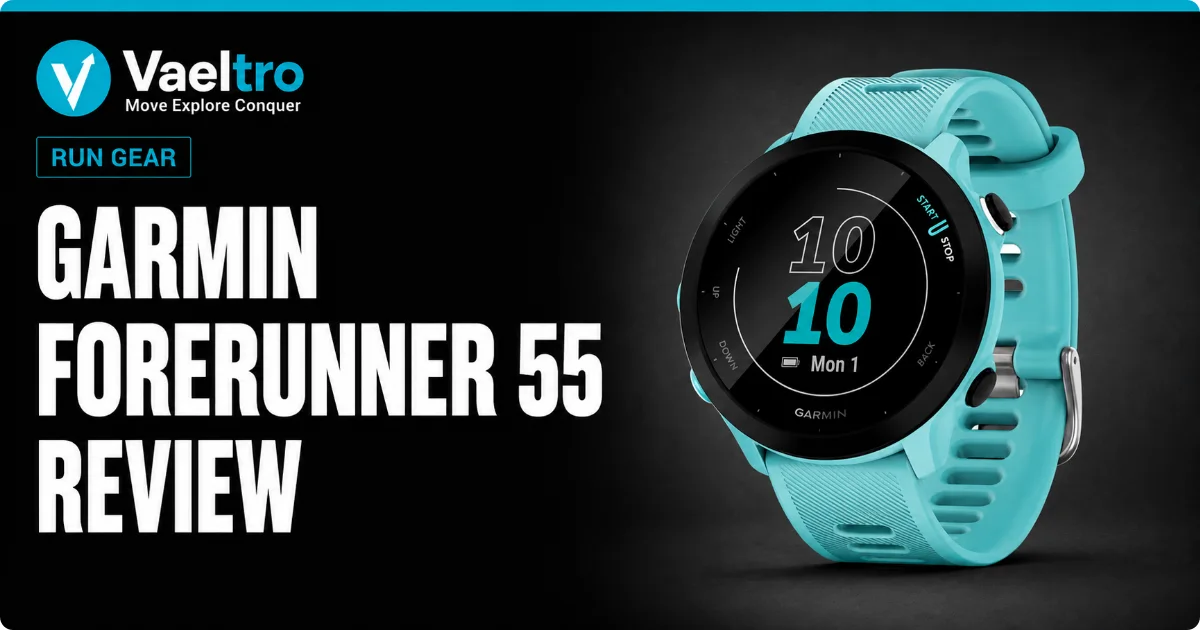
You do not need to spend $300 or more to get a capable GPS running watch. That is one of the clearest lessons the Garmin Forerunner 55 teaches.
Released in June 2021, the Forerunner 55 was designed for runners who want reliable tracking without paying for features they will never use. No mapping. No music. No touchscreen. Just clean GPS data, a long-lasting battery, and enough training guidance to help you run smarter.
But it is now a few years old, and Garmin has since released the Forerunner 165. So the real question for anyone shopping in 2026 is whether the Forerunner 55 still deserves your money or whether time has finally caught up with it.
Quick Answer
The Garmin Forerunner 55 is still a solid GPS running watch for beginners and casual runners who want accurate tracking, a two-week battery, and simple training tools at an affordable price. If you can spend roughly $75 more, the Forerunner 165 offers a significantly better display and more training features. But at its current street price of around $149, the Forerunner 55 remains genuinely useful.
What Is the Garmin Forerunner 55?
The Forerunner 55 is Garmin’s most affordable dedicated running watch. It succeeded the Forerunner 45 and brought several training features previously reserved for higher-end models, including PacePro, Daily Suggested Workouts, and Track Run Mode.
It was succeeded in turn by the Forerunner 165 in early 2024, which means the Forerunner 55 now occupies the budget end of Garmin’s current lineup. It retails at $199.99 MSRP but regularly sells for around $149 online, making it one of the most affordable ways to get into the Garmin ecosystem.
The watch comes in Black, Aqua, and White colorways. It uses a five-button physical interface with no touchscreen. The case measures 42 x 42 x 11.6mm and weighs just 37 grams, making it comfortable for both running and all-day wear.
Key Features Explained
GPS Tracking and Accuracy
The Forerunner 55 has built-in GPS and tracks pace, distance, and route for every run. It supports GPS only, without the multi-GNSS options (GLONASS, Galileo) found on the Forerunner 165. For most road running situations, this is not a problem. GPS lock is typically fast, and accuracy on open routes is reliable.
Where single-frequency GPS can fall short is in dense urban environments with tall buildings or heavily forested trails. If most of your running happens on open roads and parks, you are unlikely to notice any limitations.
The watch also includes Track Run Mode, which uses the known dimensions of a standard track to deliver more accurate lap distances a useful feature for anyone doing structured speed work.
Heart Rate Monitoring
The Forerunner 55 uses an optical wrist-based heart rate monitor. It tracks heart rate continuously throughout the day and during workouts. The data is reliable enough for general training awareness, pace zones, and Body Battery calculations.
It does not include a pulse oximeter for blood oxygen monitoring, which is available on higher-end Forerunner models. For most recreational runners, that omission is easy to live with.
If you want more precise heart rate data for interval training or heart rate zone work, the watch is compatible with ANT+ chest straps, which can be paired for more accurate readings during hard efforts.
Battery Life
This is one of the Forerunner 55’s strongest selling points. Garmin rates battery life at up to 14 days in smartwatch mode and up to 20 hours in GPS mode. In real-world use, most runners can expect to charge the watch roughly once a week depending on how many GPS-tracked runs they log.
That is a meaningful advantage over the Forerunner 165, which manages about 11 days in smartwatch mode and 19 hours with GPS running. The trade-off for the 165’s AMOLED display is a reduction in battery efficiency.
If you are training for a marathon or simply dislike charging devices frequently, the Forerunner 55’s battery life is one of the cleanest reasons to choose it.
Training Tools
Despite being the entry-level option, the Forerunner 55 comes with a useful set of training features.
Daily Suggested Workouts generate run recommendations based on your recent activity, training load, and recovery time. These are not generic suggestions they pull from your history in Garmin Connect to propose runs at appropriate intensities.
Garmin Coach provides free training plans for 5K, 10K, and half marathon distances. Plans are adaptive, meaning they adjust to your progress rather than sticking to a fixed schedule. Workouts sync directly to the watch.
PacePro is a race-day pacing tool that generates a GPS-based pace strategy for a selected course or distance. You set a goal time, and the watch guides your effort split by split.
Race Predictor estimates your finish time for common race distances based on your recent training and VO2 Max data.
VO2 Max Estimation gives you an ongoing fitness baseline that updates as you run, helping you track improvements over time.
These tools are more than enough for a beginning or recreational runner. They cover the full journey from first 5K training plan to race-day pacing strategy.
Smart Features and Notifications
The Forerunner 55 connects to your smartphone and displays call, text, and app notifications on the watch face. It also supports Incident Detection, which can alert emergency contacts with your GPS location if it detects a sudden impact during a run. Safety features like this are worth highlighting for solo runners.
The watch does not support music storage, Garmin Pay, Wi-Fi, or NFC. It relies on Bluetooth to sync data with the Garmin Connect app. Some users have noted that syncing can occasionally take a minute or two, though this is a minor inconvenience rather than a meaningful flaw.
The Garmin Connect app itself is one of the better fitness platforms available, offering detailed workout breakdowns, training history, and access to Connect IQ for downloading additional watch faces and data fields.
What the Forerunner 55 Cannot Do
Understanding what the Forerunner 55 leaves out is just as important as knowing what it includes.
There is no barometric altimeter, which means elevation data comes from GPS rather than a pressure sensor. GPS-based elevation is less accurate and can produce inconsistent climb data, particularly on hilly terrain.
There is no touchscreen. Navigation is entirely button-based using five physical controls. This is not a disadvantage for running buttons are more reliable with sweaty hands or in wet weather but if you are used to a smartphone or smartwatch with a touchscreen, the interface will feel different at first.
There is no onboard music storage. You cannot load Spotify playlists or download songs. For music during runs, your phone stays with you.
There is no mapping or course navigation. The Forerunner 55 will show you your route after a run in Garmin Connect, but it cannot guide you along a course in real time.
Advanced training metrics like Training Status, Training Load, Training Effect, and Running Dynamics are also absent. These are features that help more experienced runners understand how their body is adapting to training over time. They are available on the Forerunner 165 and above.
None of these omissions are surprising given the price. But they are worth knowing before you buy.
How It Feels to Use Every Day
The Forerunner 55 is lightweight and unobtrusive. At 37 grams, it barely registers on your wrist. The silicone band is comfortable for all-day wear, and the watch is water-resistant up to 50 meters, so swimming and showering are not concerns.
The display is a full-color MIP screen. It is visible in bright sunlight a legitimate advantage over AMOLED screens, which can struggle in direct outdoor light without high brightness settings. At the same time, the screen resolution is noticeably modest by 2026 standards. Digits are readable, but the display has a pixelated quality that feels dated next to newer watches.
The button interface takes an hour or two to learn. Once you understand which button does what, daily use becomes second nature. Starting a run, recording laps, and reviewing stats are all straightforward.
Setup is simple. Download Garmin Connect, pair via Bluetooth, and you are running within minutes.
Is the Garmin Forerunner 55 Still Good in 2026?
The honest answer is yes, with one important caveat: it depends on what you need.
The Forerunner 55 was released in 2021, and Garmin has not refreshed it. It does not receive new hardware. The MIP display, button-only interface, and GPS-only satellite support are unchanged. On paper, it is behind newer watches.
But the core running experience GPS tracking, heart rate monitoring, training plans, PacePro, and a two-week battery works exactly as well today as it did at launch. Software updates from Garmin have kept the watch functional and stable. If your goal is to track runs, follow a training plan, and avoid charging your watch every few days, the Forerunner 55 still delivers.
The more relevant question is whether $149 is still the right price for what you get. Considering that the Forerunner 165 is available for around $225, the gap has narrowed enough to make the decision genuinely close for some runners.
Garmin Forerunner 55 vs. Forerunner 165: Should You Upgrade?
This is the comparison that matters most for anyone shopping in 2026.
The Forerunner 165 launched in early 2024 and replaced the Forerunner 55 as the clear entry-level recommendation from most running communities. It is currently priced at roughly $225 online, putting it about $75 above the Forerunner 55.
The biggest difference is the display. The Forerunner 165 has a 1.2-inch AMOLED screen at 390 x 390 resolution with touchscreen capability. The difference in clarity and color is immediately noticeable. Workout data, notifications, and navigation menus are all easier to read at a glance.
The Forerunner 165 also adds several training features the 55 lacks: Training Effect, Running Dynamics support, HRV Status, a Race Widget with adaptive training suggestions, advanced sleep tracking with nap detection, and a morning report. It supports multiple satellite systems GPS, GLONASS, and Galileo for better accuracy in challenging GPS environments.
Where the Forerunner 55 still leads is battery life. It manages 14 days in smartwatch mode and 20 hours of GPS, compared to 11 days and 19 hours for the Forerunner 165. With the AMOLED display set to always-on, the 165 drops to roughly four days a real consideration for runners who do not want to charge frequently.
| Feature | Forerunner 55 | Forerunner 165 |
|---|---|---|
| Price (approx.) | ~$149 | ~$225 |
| Display | MIP (button-only) | AMOLED 1.2-inch, touchscreen |
| Battery — Smartwatch Mode | Up to 14 days | Up to 11 days |
| Battery — GPS Mode | Up to 20 hours | Up to 19 hours |
| Satellite Systems | GPS only | GPS, GLONASS, Galileo |
| Barometric Altimeter | No | No |
| Music Storage | No | Yes (Music edition only) |
| Training Effect | No | Yes |
| HRV Status | No | Yes |
| Running Dynamics | No | Yes |
| PacePro | Yes | Yes |
| Daily Suggested Workouts | Yes | Yes |
| Garmin Coach | Yes | Yes |
| Weight | 37g | 39g |
If $75 is within your budget and you plan to run seriously for more than a few months, the Forerunner 165 is the stronger long-term investment. If you are buying your first GPS watch and want to spend as little as possible to see if you actually use it, the Forerunner 55 is a smarter starting point.
Who Should Buy the Garmin Forerunner 55?
The Forerunner 55 makes the most sense for a specific type of runner.
It is a strong fit if you are new to GPS running watches and want to start with something affordable and uncomplicated. The learning curve is short, the interface is clean, and the training tools are genuinely helpful without being overwhelming.
It is also a good choice if you are a casual runner who tracks two to four runs per week, does not care about music during runs, and trains primarily on familiar roads. The core features cover everything you need, and the two-week battery means the watch is reliably ready when you are.
It is a reasonable option if you find the Forerunner 55 at a significant discount below $130 and the Forerunner 165 is not on sale.
It is a harder sell if you are training for a marathon or half marathon and want detailed recovery metrics. It is also less suitable if you run trails where elevation accuracy and multi-satellite GPS would improve your data. And if you have ever used an AMOLED display on a smartwatch, the Forerunner 55’s screen will feel like a step back.
Final Verdict
The Garmin Forerunner 55 is not the most advanced running watch available, and in 2026, it is not even Garmin’s most current entry-level option. But it is still a genuinely useful GPS watch that delivers accurate tracking, reliable battery life, and a solid set of training tools at a price that is hard to argue with.
If your priority is simplicity, affordability, and battery life, the Forerunner 55 earns its place. If your budget allows the extra $75 and you want a better screen, more training data, and support for multiple satellite systems, the Forerunner 165 is the smarter buy for most runners.
Buy the Forerunner 55 if you want a no-frills GPS watch that works every time you lace up. Step up to the Forerunner 165 if you want a watch that grows with your running over the long term.
