

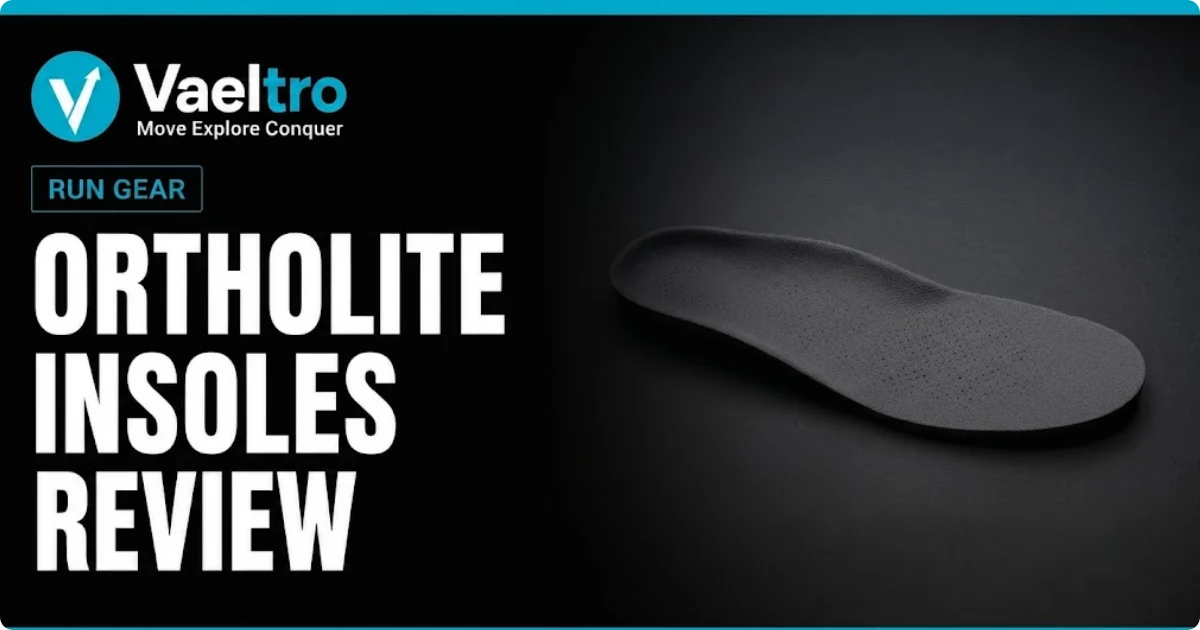
You have probably worn OrthoLite insoles without realizing it. If you own a pair of shoes from adidas, Asics, New Balance, Merrell, Salomon, or dozens of other brands, there is a good chance OrthoLite foam is already under your foot. The name appears on a small tag inside the shoe, and most people walk right past it.
But more runners and hikers are starting to pay attention. OrthoLite has become one of the most widely used insole technologies in performance footwear, and the question keeps coming up: are these insoles actually doing something useful, or are they just marketing padding between your foot and a midsole?
This guide breaks down what OrthoLite insoles are, how they perform across running and hiking, and whether they genuinely deserve a place in your shoes or whether you should replace them with something better.
What Are OrthoLite Insoles?
OrthoLite is not a shoe brand. It is a foam technology company, founded in 1997, that manufactures insoles for other footwear companies. Their insoles are built into more than 100 million pairs of shoes annually, making them one of the most common insole systems in the world.
The company produces several foam formulations, with each brand partner using whichever version fits their shoe’s intended use. What the insoles share is a consistent foundation: open-cell foam construction.
How OrthoLite’s Open-Cell Foam Works
Standard insole foam uses a closed-cell structure, which traps air and heat inside the material. OrthoLite uses open-cell foam, which means each cell in the material connects to neighboring cells, allowing air to move through the insole as you walk or run.
When your foot presses down, the foam compresses and pushes warm, moist air out through the cells. When your foot lifts, the foam rebounds and draws cooler air back in. The result is a built-in ventilation cycle that happens with every step.
This structure also contributes to the foam’s resilience. Because the cells are open and interconnected, the material can compress and rebound repeatedly without the cell walls collapsing on themselves the way closed-cell foam eventually does.
OrthoLite as an OEM Technology vs. an Aftermarket Product
This is where a lot of confusion starts. OrthoLite insoles exist in two forms, and they are not the same product.
The most common version is the OEM insole a version of OrthoLite foam designed specifically for a shoe manufacturer and built directly into a particular model. These are tuned to work with that shoe’s stack height, midsole firmness, and intended use. When you buy a pair of Salomon X Ultra trail shoes, the OrthoLite insole inside was developed to complement that specific platform.
OrthoLite also sells standalone aftermarket insoles through Amazon and select retailers. These are generic versions of the foam not tuned to any particular shoe. They can be trimmed to fit and dropped into most footwear, but they do not carry the same level of shoe-specific engineering as the OEM version.
When someone asks “are OrthoLite insoles good,” the answer depends on which product they are actually talking about.
Key Features of OrthoLite Insoles
Cushioning and Durability
OrthoLite’s most frequently cited claim is that their insoles retain 95% of their original cushioning after the first year of use. Independent testing supports this figure, and it is one of the reasons so many performance shoe brands choose OrthoLite over generic foam alternatives.
For runners and hikers, cushioning durability matters more than initial softness. A plush insole that compresses flat after a few hundred miles is worse than a moderately cushioned insole that holds its shape across a full year of use. OrthoLite’s open-cell structure is designed to prevent the kind of long-term compression set that degrades most standard insoles.
The insoles feel light noticeably lighter than many aftermarket alternatives which suits runners who prioritize a low weight penalty. They are also thinner than what many people expect, which can be surprising the first time you remove them from a shoe.
Breathability and Moisture Management
The open-cell ventilation cycle keeps feet noticeably cooler and drier compared to closed-cell foam insoles. This is most apparent in warm conditions, during longer efforts, or in hiking boots where foot heat tends to build significantly.
The difference is not dramatic in all conditions. In moderate temperatures on shorter runs, you may not notice much. But over longer distances, in summer heat, or inside a waterproof boot where airflow is already restricted, the breathability advantage becomes more meaningful.
Antimicrobial Protection
OrthoLite applies a patented antimicrobial treatment to their foam during manufacturing. This treatment inhibits the growth of bacteria and fungus on the insole surface, which reduces odor over time.
The treatment is built into the material rather than applied as a surface coating, so it does not wash off. OrthoLite insoles are also machine washable, which helps extend their useful life.
Sustainability
OrthoLite has invested in using recycled rubber content in several of their foam formulations, and the company has sustainability commitments around material sourcing and manufacturing. For runners and hikers who factor environmental impact into their gear decisions, this is worth noting though the insoles are still a synthetic foam product and not biodegradable.
How OrthoLite Insoles Perform for Running
Road Running
For road running, OrthoLite insoles provide a responsive underfoot platform that does not fight the shoe’s midsole. Because the foam is relatively thin and light, it adds cushioning without significantly altering the shoe’s intended stack height or ground feel.
Most road running shoes already pair OrthoLite with a well-cushioned EVA or PEBA midsole, so the insole’s role is to handle direct foot contact, absorb foot heat, and provide a clean, smooth surface against the sock. It does this well.
Where OrthoLite falls short for some road runners is arch support. The insoles are relatively flat and neutral. Runners with mild to moderate pronation who rely on the shoe’s upper and midsole for structure will do fine. Runners who need significant medial arch support to run comfortably may find OrthoLite insufficient on its own.
Trail Running
In trail running shoes, OrthoLite’s shock absorption contributes meaningfully to the underfoot feel on technical terrain. The foam cushions foot-to-rock impacts that the outsole and midsole alone do not fully absorb.
The breathability advantage is also more apparent on trails, where effort levels are higher and conditions are more variable. Hikers and trail runners who have switched to OrthoLite-equipped shoes often report needing to wash the insoles less frequently than they did with previous footwear consistent with the antimicrobial protection and moisture management working together.
How OrthoLite Insoles Perform for Hiking
Hiking is where OrthoLite has the most documented real-world feedback, partly because several major hiking boot brands Salomon in particular have used OrthoLite as their standard insole across multiple product lines.
The thin, lightweight profile surprises many hikers who first handle the insoles outside the boot. The expectation is that a good hiking insole should be thick and visibly padded. OrthoLite challenges that assumption by delivering shock absorption through material quality rather than material volume.
In long hiking days, particularly in warm conditions or on varied terrain, the breathability and cushioning resilience become clear advantages. The insoles do not break down the way standard foam footbeds do over a full season of use, which matters for hikers who spend significant time on the trail each year.
The insoles work best in boots with a supportive structure where the boot itself handles torsional rigidity and the insole handles comfort and climate control. In a less structured shoe or on terrain that demands significant lateral support, the flat, neutral profile of OrthoLite may not provide everything an experienced hiker needs.
OrthoLite Insoles for Flat Feet and Plantar Fasciitis
This is the most searched question about OrthoLite insoles, and it deserves a direct answer.
OrthoLite insoles are not orthotic insoles. They are comfort and performance insoles. There is an important difference.
For flat feet, the concern is whether the insole provides sufficient arch support to reduce strain on the plantar fascia, tibialis posterior tendon, and knee during high-impact activity. OrthoLite’s standard insoles are relatively flat and do not provide significant medial arch support. For mild flat feet in a shoe that already has structured support built into the midsole and upper, they can work fine. For pronounced flat feet where arch support is a clinical need, OrthoLite is not a substitute for a supportive aftermarket insole or custom orthotic.
For plantar fasciitis, cushioning the heel and supporting the arch are the two primary goals. OrthoLite provides good heel cushioning and durability, but limited arch support. Some people with mild plantar fasciitis find relief in OrthoLite-equipped shoes, particularly because the insoles maintain consistent cushioning rather than compressing flat. Others with more significant plantar fasciitis will need a purpose-built insole like Superfeet Green, Powerstep Pinnacle, or a custom orthotic from a podiatrist.
If you have been told by a podiatrist that you need specific arch support or orthotic correction, OrthoLite is not a replacement for that recommendation.
OrthoLite Insoles vs. Aftermarket Alternatives
| Insole | Primary Strength | Arch Support | Breathability | Weight | Best For |
|---|---|---|---|---|---|
| OrthoLite | Cushioning and durability | Minimal (flat/neutral) | High (open-cell foam) | Very light | Neutral feet, daily running and hiking |
| Superfeet | Structural arch support | High (semi-rigid shell) | Moderate | Heavier | Overpronation, flat arches, plantar fasciitis |
| Currex RunPro | Arch-profile flexibility | Mild to moderate (foot-type variants) | Moderate | Light | Runners wanting mild support without rigid correction |
OrthoLite vs. Superfeet
Superfeet insoles are purpose-built for arch support and biomechanical correction. Their semi-rigid shell holds the rear foot in a stable position, which directly reduces strain on the plantar fascia and reduces overpronation in most users.
OrthoLite prioritizes cushioning, breathability, and lightweight performance. Superfeet prioritizes structural support, which means they are heavier, firmer, and more corrective.
For runners and hikers with neutral feet who want the best cushioning and climate performance from their shoe, OrthoLite is the better daily insole. For runners and hikers who pronate, have flat arches, or experience chronic lower limb discomfort on long efforts, Superfeet addresses problems that OrthoLite is not designed to solve.
The two are not competitors in the same category, despite sitting in similar retail spaces.
OrthoLite vs. Currex
Currex insoles occupy a middle ground between OrthoLite’s flat comfort platform and Superfeet’s rigid correction. Currex designs arch profiles for different foot types (low, medium, and high arch variants) while maintaining a flexible, running-specific construction.
For runners in particular, Currex RunPro is often recommended as an upgrade to a stock OrthoLite insole where mild arch support and dynamic flexibility are the goal. Currex insoles do not offer the same breathability as OrthoLite, but they provide a more foot-specific underfoot experience for runners who want more than a flat platform.
If you are running in shoes with OrthoLite insoles and experiencing fatigue or discomfort specifically in the arch or heel, Currex is a logical next step before considering custom orthotics.
Should You Replace Your OrthoLite Insoles?
For most runners and hikers, the answer is no not immediately, and not just for the sake of upgrading. OrthoLite insoles are a quality base, and replacing them with an inferior aftermarket option could make things worse.
Signs It Is Time to Replace Them
The clearest sign that OrthoLite insoles need replacing is visible compression. If the heel pad has lost its rebound and feels flat under your weight, or if the foam surface has developed deep creasing that does not recover, the insole has exceeded its useful life.
Other signs include persistent odor that does not resolve after washing, surface wear that exposes foam beneath the top cloth, or recurring heel and arch discomfort that began after significant mileage.
OrthoLite’s 95% cushioning retention claim is specific to the first year of normal use. Heavy use marathon training, multi-day hiking, daily double sessions can shorten this timeline considerably.
Best OrthoLite Replacement Options
| Need | Recommended Replacement | Activity |
|---|---|---|
| Cushioning and comfort, no correction | OrthoLite aftermarket insole | Running and hiking |
| Mild arch support | Currex RunPro / Currex HikePro | Running / Hiking |
| Significant arch support or plantar fasciitis | Superfeet Green / Powerstep Pinnacle | Hiking / Running |
| Persistent, activity-limiting discomfort | Custom orthotic (podiatrist-prescribed) | Running and hiking |
When the time comes to replace OrthoLite insoles, your choice should depend on what you need most.
For cushioning and comfort without arch correction, a replacement OrthoLite aftermarket insole is a straightforward option. These are available through Amazon and keep the same performance characteristics as the original.
For mild arch support, Currex RunPro (running) or Currex HikePro (hiking) offer a step up in structure without going fully corrective.
For significant arch support or plantar fasciitis management, Superfeet Green (hiking) or Powerstep Pinnacle (running) are well-established choices with strong track records.
If your discomfort is persistent and activity-limiting, consulting a podiatrist before purchasing aftermarket insoles is worth the time. A custom orthotic prescribed for your specific foot mechanics will outperform any over-the-counter option.
Who OrthoLite Insoles Are Not For
OrthoLite insoles are not a good fit for everyone, and knowing this upfront saves both money and discomfort.
They are not suitable as a standalone solution for runners or hikers with significant overpronation. The flat profile provides no meaningful medial support, and wearing them in a neutral shoe when you need motion control can increase injury risk over time.
They are not a replacement for custom orthotics. If you have been prescribed orthotics by a healthcare provider, replacing them with OrthoLite even in a well-cushioned shoe does not replicate the biomechanical correction your orthotics provide.
They are also not ideal for runners with very high arches who tend to supinate. High-arch feet do not absorb shock well and often need a well-cushioned, flexible insole with built-in arch fill. OrthoLite’s flat neutral platform leaves a gap that can cause lateral foot pain on longer efforts.
Finally, the aftermarket standalone insoles are a different product from the OEM versions built into branded shoes. If you buy aftermarket OrthoLite insoles expecting the same fit and feel as those in your Salomon boots, you may be disappointed. The shoe-specific versions are engineered for that platform; the aftermarket versions are general-purpose.
Where to Buy OrthoLite Insoles
OrthoLite aftermarket insoles are sold through Amazon and select running and outdoor retailers. The brand’s website (ortholite.com) provides information on the technology and lists shoe brand partners, but direct-to-consumer retail is primarily through third-party platforms.
When buying on Amazon, verify the seller is reputable and check whether the product listing matches the trim size you need for your shoe length. Counterfeit insoles using the OrthoLite name do appear occasionally in online marketplaces.
For OEM versions of OrthoLite insoles already built into shoes, the best source is simply buying the shoe from an authorized retailer. The insole will be matched to that shoe’s design.
For in-person buying, specialist running stores and outdoor retailers sometimes carry aftermarket OrthoLite options alongside other performance insole brands, which makes side-by-side comparison easier.
Final Verdict
OrthoLite insoles earn their reputation for a straightforward reason: they do what a quality stock insole should do, and they do it consistently. The open-cell foam provides reliable cushioning, genuine breathability, and durable performance across both running and hiking applications. The 95% cushioning retention figure is not marketing fiction it reflects a real material advantage over standard foam footbeds.
The limitation is equally straightforward. OrthoLite is a neutral comfort platform, not a corrective insole. Runners and hikers with flat feet, overpronation, plantar fasciitis, or high arches who need structural support will not get that from OrthoLite alone.
If your feet are biomechanically neutral and your goal is a well-cushioned, breathable, long-lasting insole, the OrthoLite that came with your shoes is very likely already the right choice. If you need arch support or foot correction, the right move is a purpose-built aftermarket insole or a visit to a podiatrist not a generic upgrade.
