

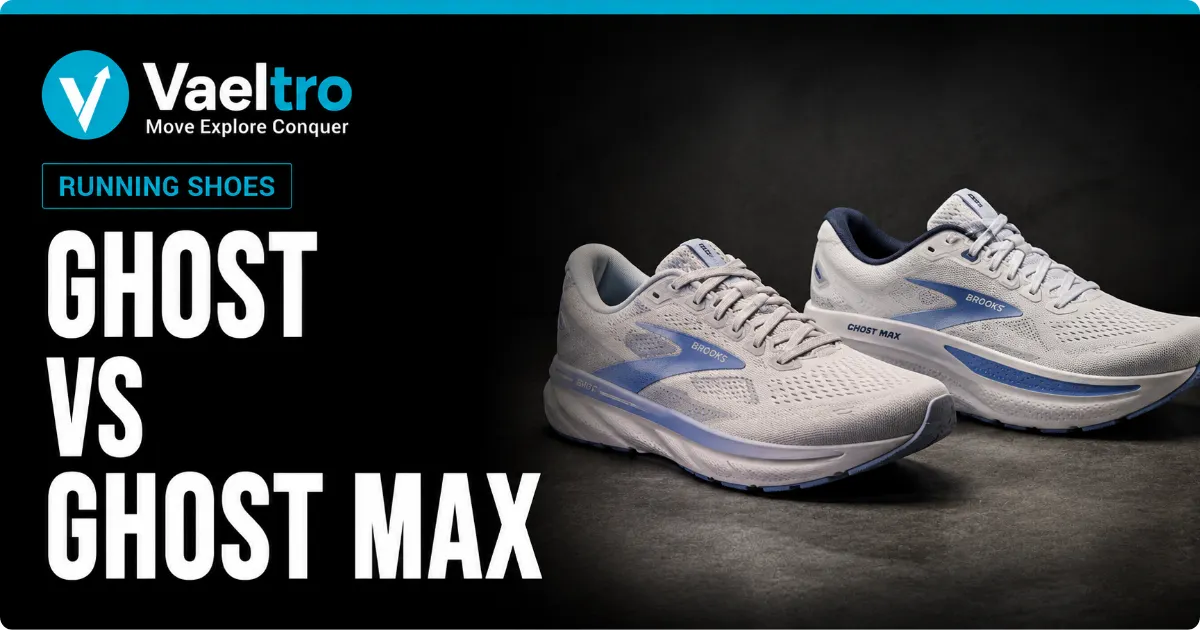
Brooks Ghost vs Ghost Max: Which Cushioned Trainer Should You Buy?
They share a name, a brand, and the same core midsole foam. Beyond that, the Brooks Ghost and the Brooks Ghost Max are built for very different runners doing very different things.
The confusion is understandable. When a shoe is called the “Ghost Max,” it sounds like a bigger, plusher version of the original. That assumption leads a lot of runners to the wrong shoe. The Ghost Max is not simply a maxed-out Ghost it is a separate design with a different geometry, a different drop, and a different purpose on the road.
This comparison covers both shoes across every dimension that matters: cushioning, stack height, drop, fit, ride feel, walking use, and injury support. By the end, you will know exactly which one suits your running.
What Makes These Two Shoes Different
The short version: the Ghost is a versatile daily trainer built for a wide range of paces and distances. The Ghost Max is a stability-focused, rocker-geometry shoe built for easy efforts, long slow miles, and runners who need extra underfoot protection.
Both use Brooks’ DNA Loft v3 nitrogen-infused foam. That shared foam is where the similarity ends.
The Ghost Max adds a significantly thicker midsole, a broader base, a more pronounced GlideRoll rocker, and a lower heel-to-toe drop. Those four changes combine to produce a shoe that feels and performs very differently from the standard Ghost even though the two shoes sit side by side in the Brooks lineup and cost nearly the same.
Understanding that distinction upfront saves a lot of frustration at the shoe store.
Midsole and Cushioning: Where They Really Part Ways
Brooks Ghost Balanced Cushioning for Everyday Miles
The Ghost has always been one of the most consistent daily trainers in running. Version after version, it delivers a reliable, comfortable ride that works for easy runs, moderate long runs, and even uptempo sessions.
The midsole is cushioned without being soft to the point of instability. Runners describe it as “balanced” — enough protection underfoot to handle high mileage, but firm enough to feel responsive when the pace picks up. The forefoot is flexible, which helps runners who land further forward rather than on the heel.
In the Ghost 17, Brooks added 2mm of foam in the heel and 4mm in the forefoot compared to the Ghost 16, bringing the cushioning level noticeably closer to what the Ghost Max offers. Even so, the Ghost remains the firmer, more versatile of the two.
Brooks Ghost Max Rocker Geometry Changes Everything
The Ghost Max is cushioned differently. It is not simply thicker foam it is a reshaped midsole with a curved geometry at the base that actively guides the foot through each stride.
Brooks calls this GlideRoll technology. The curved rocker promotes a smoother heel-to-toe transition, which reduces the amount of work the foot and ankle have to do at push-off. For runners dealing with foot fatigue, plantar fasciitis, metatarsalgia, or Morton’s neuroma, that smoother transition can meaningfully reduce discomfort over a long run or walk.
One important clarification: the Ghost Max does not feel like a plush, marshmallow-soft shoe underfoot. Runners expecting the sink-in softness of something like the HOKA Bondi or ASICS Gel-Nimbus often find the Ghost Max firmer than anticipated. The cushioning is protective and stable, not pillowy.
The broad midsole base adds natural stability that the standard Ghost cannot match. The Ghost Max sits wider underfoot, which helps keep the foot in a neutral position across the gait cycle a useful feature for runners who tend toward mild overpronation but do not need a dedicated stability shoe.
Stack Height and Drop: The Numbers That Matter
| Spec | Ghost 17 | Ghost Max 3 |
|---|---|---|
| Heel Stack | 37mm | 39mm |
| Forefoot Stack | 27mm | 33mm |
| Heel-to-Toe Drop | 10mm | 6mm |
Stack height is where the Ghost and Ghost Max diverge most clearly on paper.
The Ghost Max 3 measures 39mm at the heel and 33mm in the forefoot, producing a 6mm heel-to-toe drop. The Ghost 17 measures 37mm at the heel and 27mm in the forefoot, producing a 10mm drop.
Those numbers reveal two things. First, the Ghost Max has significantly more foam in the forefoot — 6mm more than the Ghost 17. That extra forefoot stack is what enables the rocker geometry to function correctly. Second, the lower drop of the Ghost Max encourages a more midfoot-oriented ground contact, which contributes to the stability advantage the shoe offers.
For context on how the series has evolved: the original Ghost Max (paired with the Ghost 15) had the same 6mm drop and a similar rocker design. The Ghost 15 ran with a 12mm drop, making the gap between the two shoes even wider than it is today. Subsequent generations have gradually increased the Ghost’s forefoot stack, bringing the drop down from 12mm to 10mm, while the Ghost Max has remained consistent in its low-drop, high-stack identity.
Runners moving from the Ghost 15 specifically will notice the biggest adjustment stepping into the Ghost Max not just in cushioning volume, but in how the lower drop changes stride feel and calf load.
Weight and Ride Feel
| Weight | Ghost 17 | Ghost Max 3 |
|---|---|---|
| Men’s | 286g (10.1oz) | 306g (10.8oz) |
| Women’s | 255g (9oz) | 275g (9.7oz) |
The Ghost Max 3 weighs approximately 306g (10.8oz) for men and 275g (9.7oz) for women. The Ghost 17 comes in lighter at around 286g (10.1oz) for men and 255g (9oz) for women.
That roughly 20g difference is noticeable over longer distances. The Ghost feels more nimble underfoot, which makes it the better choice for runners who want to mix easy miles with the occasional faster effort. Picking up the pace feels natural in the Ghost. In the Ghost Max, it is possible, but the shoe is not designed for it the rocker and broader base are optimized for steady, controlled movement, not speed.
For truly easy efforts recovery runs, long slow distance, daily jogs at conversation pace the Ghost Max’s ride feels smooth and efficient. The rocker does a lot of the propulsive work, so the legs do not have to push as hard at the end of each stride.
Upper and Fit
Both shoes fit true to size in length. There is one meaningful fit difference worth noting.
The Ghost Max, particularly in the third generation, has a rounder, deeper toe box with more volume in the forefoot. This suits runners with a higher instep or a wider forefoot. It is not a wide-fit shoe by design, but the additional volume means it accommodates more foot shapes than the standard Ghost does.
The Ghost 17 has a more standard running shoe shape. It fits securely across the midfoot and heel. Runners with narrow to average feet often find the Ghost fits better; runners with broader feet or high-volume feet may find the Ghost Max more comfortable across the forefoot without needing to size up.
Both shoes are available in wide and extra-wide widths through Brooks directly, which is worth knowing for buyers at either end of the width spectrum.
In terms of heel lockdown, the Ghost has a slight edge. The upper construction wraps the heel more precisely, which some runners prefer for faster running or for anyone prone to heel slippage.
Who Should Buy the Brooks Ghost
The Ghost suits runners who want a dependable, versatile daily trainer that can handle most of what they throw at it.
It works well for:
- Runners who mix easy miles with moderate to uptempo sessions
- Runners who prefer a more responsive, less structured ride
- Runners coming from traditional heel-drop shoes (10mm drop feels familiar)
- Narrower-footed runners who want a secure, precise fit
- Anyone who runs at a variety of paces across the week
The Ghost is not the right choice for runners who primarily need underfoot protection for slow, long efforts. It is also less suited to walkers or to runners dealing with forefoot pain conditions, where the Ghost Max’s rocker design offers meaningful advantages.
Who Should Buy the Brooks Ghost Max
The Ghost Max suits runners who prioritize protection, stability, and smooth transitions over pace versatility.
It works well for:
- Runners who do most of their miles at easy, conversational pace
- Heavier runners who benefit from a broader, more supportive base
- Runners with mild overpronation who do not need a full stability shoe
- Anyone managing plantar fasciitis, metatarsalgia, or forefoot pain
- Runners who prefer a lower drop or are working toward one
- Runners with wider feet or a higher instep who want more forefoot volume
The Ghost Max is not the right choice for runners who want to run at a variety of paces. It lacks the forefoot flexibility and lighter feel that make faster running comfortable. Runners expecting ultra-soft, sink-in cushioning will also be surprised the Ghost Max is protective and stable, not plush.
Brooks Ghost vs Ghost Max for Walking
For walking, the Ghost Max has a clear advantage.
The rocker geometry that aids runners at easy pace works even better for walkers. It promotes a smooth heel-to-toe roll through each step, reducing impact on the forefoot and taking load off the plantar fascia and ankle joints. The broad midsole base provides the kind of lateral stability that walkers benefit from especially on longer walks or for those on their feet for extended periods.
The liner last construction in the Ghost Max also accommodates orthotics more naturally than most running shoes. Orthotics tend to fit poorly in shoes with a curved last because the shape mismatch creates pressure points along the upper edges. The straighter last of the Ghost Max reduces that problem significantly.
The standard Ghost is also a perfectly capable walking shoe, but it does not offer the same purposeful walking-specific benefits as the Ghost Max. For runners who walk significant daily mileage as part of training or recovery, the Ghost Max is the more appropriate tool.
Is the Ghost Max Good for Plantar Fasciitis?
Brooks specifically cites the Ghost Max’s rocker geometry and midsole design as potentially beneficial for plantar fasciitis, metatarsalgia, and Morton’s neuroma. The mechanism behind this claim is straightforward: by promoting smoother heel-to-toe transitions, the shoe reduces peak loading on the forefoot structures during each stride.
The broad base also helps stabilize the foot through the gait cycle, which can limit the amount of pronation-related strain on the plantar fascia.
That said, a shoe is not a treatment. Plantar fasciitis responds to a combination of rest, soft tissue work, strengthening, and load management. The Ghost Max can be a useful part of that picture — and for many runners dealing with early-stage plantar fasciitis, switching to a shoe with more forefoot cushioning and a rocker can reduce daily discomfort meaningfully.
For comparison, the standard Brooks Ghost offers less forefoot protection and no rocker geometry, which makes it less targeted for this use case. The Brooks Glycerin offers more overall softness but without the rocker design. Many runners dealing with forefoot pain find the Ghost Max more effective than either the Ghost or the Glycerin specifically because of its geometry, not its cushioning depth.
Ghost Max 2 vs Ghost 16 and How the Generations Line Up
| Generation | Ghost Model | Ghost Drop | Ghost Max Model | Ghost Max Drop |
|---|---|---|---|---|
| 1st | Ghost 15 | 12mm | Ghost Max 1 | 6mm |
| 2nd | Ghost 16 | 10mm | Ghost Max 2 | 6mm |
| 3rd | Ghost 17 | 10mm | Ghost Max 3 | 6mm |
A common source of confusion is figuring out which Ghost Max generation pairs with which Ghost generation. Here is a clean breakdown of how the two series have evolved together:
The original Ghost Max launched alongside the Ghost 15. It introduced the GlideRoll rocker and the broad, low-drop midsole platform that defined the series. The Ghost 15 ran with a 12mm drop, making the difference between the two shoes especially pronounced.
The Ghost Max 2 arrived with the Ghost 16. Both shoes retained DNA Loft v3 foam. The Ghost Max 2 kept the same 6mm drop and rocker geometry. The Ghost 16 settled at a 10mm drop.
The Ghost Max 3 and Ghost 17 are the current generation. The Ghost 17 gained 2mm of heel stack and 4mm of forefoot stack compared to the Ghost 16, softening its overall feel. The Ghost Max 3 updated the upper with a rounder, roomier toe box and a slightly more prominent rocker, while keeping the core midsole geometry unchanged.
Runners asking specifically about the Ghost 15 vs Ghost Max comparison are essentially asking about the first generation of this contrast and that version showed the greatest performance difference between the two, particularly in heel drop.
Brooks Ghost vs Ghost Max vs Glycerin: How Do They Compare?
Runners comparing these three models are usually shopping for long-distance comfort and want to understand where each shoe sits in the Brooks cushioning range.
The Ghost is the most versatile of the three. It handles a wide range of paces and distances and is the lightest of the group. It is the right choice for runners who want one dependable shoe for most of their training.
The Ghost Max sits above the Ghost in terms of underfoot protection and stability, but its rocker geometry makes it more specialized. It works best at easy to moderate paces and offers specific benefits for forefoot pain and walking use.
The Glycerin is the plushest of the three. It offers more sink-in softness than the Ghost Max, but without the rocker design. Runners who simply want the softest possible ride and do not need the biomechanical features of the Ghost Max will find the Glycerin more comfortable at easy paces. Runners dealing with forefoot-specific pain or who prefer stability over pure softness may find the Ghost Max the more practical option despite its firmer feel.
Final Verdict
The Brooks Ghost and Brooks Ghost Max are not competing versions of the same shoe they are two different shoes designed for two different types of runners.
The Ghost remains one of the most reliable daily trainers available. It is versatile, consistent, and comfortable across a wide range of paces and distances. Runners who want a single shoe that handles easy miles, moderate long runs, and the occasional faster effort without needing to think too hard about it will find the Ghost a dependable choice.
The Ghost Max is the right pick for runners who log most of their miles at easy pace, who need extra protection for longer distances, or who are managing forefoot discomfort or plantar fasciitis. Its rocker geometry and broader base provide a distinctly different experience from the standard Ghost one that is more protective, more stable, and more purposeful for slow, steady movement. It also earns its place as one of the better running shoes for extended walking use.
The confusion between these two shoes comes from the name. “Max” implies more of the same, and it is not. Once that expectation is corrected, the choice becomes straightforward: run at a variety of paces and want versatility, choose the Ghost. Run slow, run far, need protection or stability, choose the Ghost Max.
