

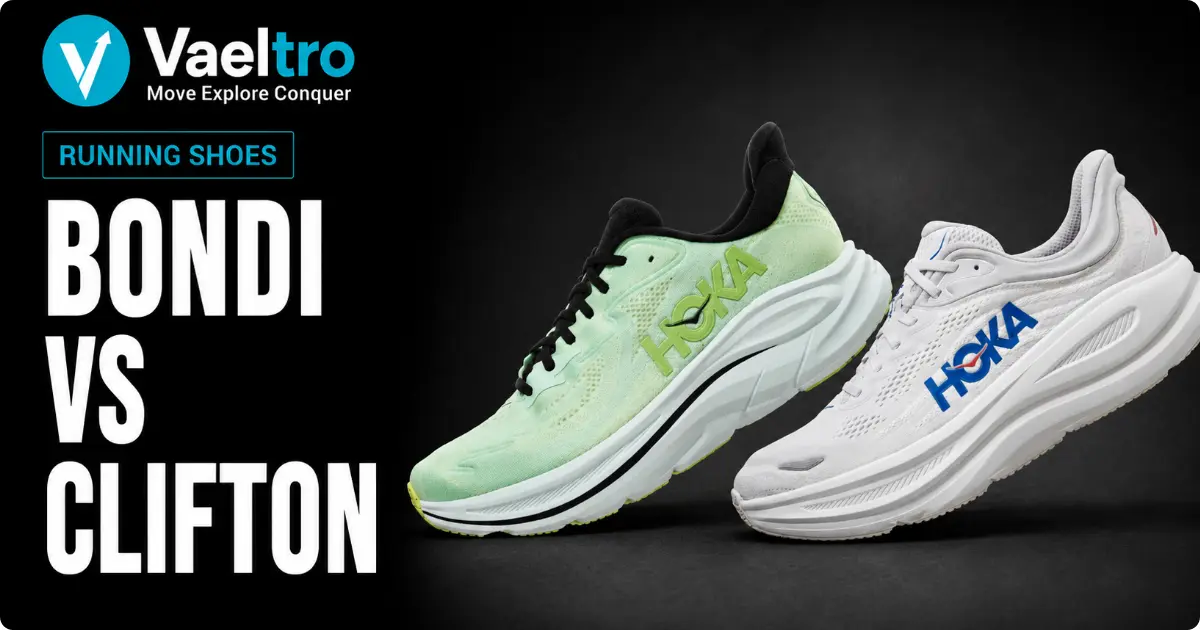
HOKA has built a loyal following around the idea that more cushioning is almost always better. Both the Bondi and the Clifton sit at the cushioned end of the brand’s lineup, and from a distance they look remarkably simila oversized midsole, rocker geometry, low-to-the-ground platform, and that unmistakable HOKA silhouette.
So why do so many people struggle to choose between them?
Because the difference is not about how much cushioning you get. It is about what kind. These two shoes deliver cushioning in fundamentally different ways, and buying the wrong one even within the same brand, even within the same style means ending up with a shoe that does not quite fit how you move or what you need it to do.
This guide breaks down every meaningful difference between the Bondi and the Clifton so you can stop second-guessing and start running.
What These Two Shoes Actually Have in Common
Before getting into the differences, it helps to understand the shared design philosophy behind both shoes.
Both the Bondi and the Clifton are neutral, max-cushion road shoes built on HOKA’s extended midsole platform. Both feature a Meta-Rocker a curved geometry that rolls the foot forward through the gait cycle, reducing demand on the ankle and calf. Both sit high off the ground with substantial stack heights. Both use an engineered knit upper. And both are sold as daily trainers capable of handling long mileage.
For someone coming from a more traditional running shoe, either of these will feel dramatically different. The rocker geometry alone changes the way the foot loads and transitions, and many runners find it takes a few runs to adjust. That adjustment period is worth knowing about before you commit to either model.
The Core Difference: Foam Feel and Ride Character
| Attribute | HOKA Bondi | HOKA Clifton |
|---|---|---|
| Foam Type | Supercritical EVA | CMEVA (compressed EVA) |
| Ride Feel | Plush, soft, smooth | Firmer, responsive, energetic |
| Responsiveness | Low — absorbs energy | Higher — returns energy |
| Best Use | Easy runs, recovery, all-day wear | Daily training, varied pace |
The single most important difference between the Bondi and the Clifton is the midsole foam not just how thick it is, but how it behaves underfoot.
HOKA Bondi Maximum Plush, Maximum Protection
The Bondi uses a supercritical EVA foam in its midsole. This is a more advanced foam compound that undergoes a pressurized production process, resulting in a lighter, softer, and more resilient material. The result is a noticeably plush feel one that absorbs impact aggressively and leaves very little of that impact traveling up through the ankle, knee, and hip.
The Bondi is not merely soft in the way a worn-out shoe feels soft. The foam maintains its structure under load. It compresses, absorbs, and returns to shape efficiently. Runners who put high mileage on the Bondi consistently report that the foam holds up well and the cushioning does not feel substantially degraded after several hundred miles.
The ride character of the Bondi leans toward smooth and deliberate. It is not a shoe that encourages quick turnover or pace variation. It is built for sustained, comfortable forward motion long easy runs, recovery days, or simply getting through extended time on your feet without accumulating fatigue.
HOKA Clifton Cushioned but Capable
The Clifton uses HOKA’s CMEVA foam a compressed EVA compound that is lighter and firmer than the supercritical foam in the Bondi. It delivers genuine cushioning, more than most standard daily trainers on the market, but it does so with noticeably more responsiveness and ground feedback.
The Clifton feels energetic in a way the Bondi does not. When pace picks up, the midsole responds. When the foot loads and pushes off, there is a degree of pop that the Bondi’s softer foam does not provide. This makes the Clifton better suited to a wider range of training easy miles, moderate-paced runs, and even light tempo work if needed.
For runners who want one shoe that handles everything from slow recovery jogs to brisker daily miles, the Clifton’s versatility is a genuine advantage.
Stack Heights, Drop, and What They Mean in Practice
| Spec | HOKA Bondi 9 | HOKA Clifton 10 |
|---|---|---|
| Heel Stack Height | 43mm | 42mm |
| Forefoot Stack Height | 38mm | 34mm |
| Heel-to-Toe Drop | 5mm | 8mm |
The stack height difference between the Bondi and Clifton is smaller than most people expect, but the heel drop difference is significant and worth paying attention to.
The Bondi 9 carries a 43mm heel stack and a 38mm forefoot stack, producing a 5mm heel-to-toe drop. The Clifton 10 has a 42mm heel stack and a 34mm forefoot stack, producing an 8mm drop.
That extra 4mm of forefoot stack height in the Bondi is what changes the feel most. A lower drop encourages the foot to land closer to a mid-foot position, which reduces the degree of heel striking and places more demand on the calf and Achilles particularly for walkers and runners transitioning from higher-drop shoes.
The Clifton’s 8mm drop is more traditional and accommodating of heel-strike patterns. For runners who land on their heel naturally, or for walkers who spend long hours on their feet and are used to supportive footwear with a raised heel, the Clifton tends to feel more immediately comfortable without a significant transition period.
Neither drop is universally better. But if you are coming from a standard trainer or a cushioned lifestyle shoe, the Clifton’s 8mm drop will likely feel more familiar from day one.
Fit, Width, and Upper Construction
Both shoes use engineered knit uppers, but the construction differs in ways that affect how each shoe fits across different foot shapes.
Bondi Fit
The Bondi is built on a wider last. The toe box is roomy, and the forefoot allows for natural toe splay. The heel collar is lined with memory foam, which molds to the shape of the individual foot over time and gives the Bondi a slightly more premium, adaptive feel at the ankle.
HOKA recommends sizing up by half a size in the Bondi, as the fit runs slightly narrow in the midfoot despite the wider toe box. The wide version is available for runners who need additional room throughout.
For people with broader feet, bunions, or those who simply prefer space in the forefoot, the Bondi’s fit is usually the more comfortable of the two without needing to adjust sizing.
Clifton Fit
The Clifton has a more performance-oriented fit. The heel counter is firmer and more structured, locking the heel in place for a secure feel during running. The midfoot wraps with an active foot frame that adds containment. The toe box, while adequate for most foot shapes, is narrower than the Bondi’s.
The Clifton fits true to size for most runners. A wide version is also available. Runners with narrower feet or those who prefer a more wrapped, locked-down feel tend to prefer the Clifton’s upper. The more structured construction does mean it can feel slightly restrictive for those with broader feet.
Stability and Platform Width
Despite both being neutral shoes, neither the Bondi nor the Clifton feels unstable in the way high-stack shoes sometimes do.
The Bondi has a measurably wider midsole base. The forefoot platform is broader, and the midsole walls extend up around the sides of the foot, creating what functions like a stability cradle. The heel drops slightly into the platform rather than sitting on top of it a design feature HOKA specifically improved in the Bondi 9 to address instability complaints about earlier generations. The result is a shoe that feels planted even though the stack height is substantial.
The Clifton’s platform is narrower than the Bondi’s, but the firmer CMEVA foam provides a more direct ground connection that many runners find inherently more stable when moving at pace. The active foot frame adds midfoot structure without adding bulk.
For heavier runners or those who have historically felt unstable in high-cushion shoes, the Bondi’s wider, more wrapping platform is the safer choice. For runners who find a firmer, more responsive foam easier to control, the Clifton delivers stability through stiffness rather than width.
Outsole Coverage and Long-Term Durability
One of the clearest structural differences between the two shoes is outsole rubber coverage — and it has a direct impact on how long each shoe lasts.
The Clifton has rubber on the forefoot and rearfoot, but the midfoot area uses exposed EVA foam. This saves weight but creates a vulnerability. In moderate-to-high mileage runners, the exposed midfoot EVA begins to wear down, gradually reducing the shoe’s cushioning and protection in that zone.
The Bondi has more generous rubber coverage, including the lateral midfoot, which are high-wear areas for many runners. The additional outsole weight contributes to the Bondi being heavier overall, but the tradeoff is meaningfully longer shoe life. Runners who log high mileage or want to maximize the lifespan of a single pair will generally find the Bondi outlasts the Clifton.
Weight Difference Does It Actually Matter?
The Bondi is heavier than the Clifton. The difference is roughly one to two ounces depending on size and gender, with the Clifton typically coming in around 9 to 9.5 ounces for a men’s size 9 and the Bondi around 10.5 to 11 ounces.
For most runners using either shoe as a daily trainer or for easy mileage, this difference is unlikely to affect performance in any meaningful way. Neither shoe is designed for fast running, and neither is marketed as a lightweight trainer.
Where the weight difference becomes more noticeable is during extended time on feet — long walks, all-day wear, or shift work. Even a modest weight difference multiplied across thousands of steps in a working shift can add up to noticeable fatigue. Runners or walkers who are particularly sensitive to shoe weight may prefer the Clifton for that reason alone.
Who the Bondi Is Built For
The Bondi is the right choice when maximum cushioning and impact absorption are the priority over versatility or pace.
It suits runners who focus on easy and long runs, particularly those training at conversational pace or recovering between harder efforts. The plush foam makes high-mileage accumulation more forgiving on the body.
It is well-matched for heavier runners who need more impact absorption and benefit from the wider, more supportive platform. The Bondi absorbs energy rather than returning it, which is exactly what the body sometimes needs on recovery days or back-to-back running days.
People who spend extended hours on hard floors whether in healthcare, retail, hospitality, or other on-feet professions consistently find the Bondi’s softer foam more comfortable for all-day wear than the Clifton.
Who the Clifton Is Built For
The Clifton is the better everyday trainer for runners who want cushioning without giving up the ability to vary pace, respond to the road, or cover a range of training intensities in a single shoe.
It works well for runners who mix easy days with moderate efforts, or who simply want one shoe that handles everything from a recovery jog to a tempo effort without feeling sluggish.
The Clifton’s lower weight, firmer foam, and higher heel drop also make it a more natural transition shoe for runners coming from traditional trainers who want to try HOKA’s cushioning and rocker geometry without making a dramatic leap to the Bondi’s softness.
For walkers who prefer a responsive feel and a shoe that pairs more easily with everyday clothing, the Clifton is the more versatile option.
Who Should NOT Buy the Bondi
The Bondi is not ideal for every runner, and being honest about that matters.
Runners who care about pace and responsiveness will find the Bondi’s soft foam frustrating. The energy absorption that makes it so comfortable also reduces the snappy toe-off that faster runners depend on. If you spend any time doing tempo runs, threshold work, or racing, the Bondi is not the right tool.
People with narrow feet or those who prefer a snug, performance-oriented fit may find the Bondi’s roomier construction feels imprecise like the foot is swimming slightly inside the shoe during dynamic movements.
Budget-conscious buyers should also consider that the Bondi carries a higher price point than the Clifton. If the extra cost is a stretch, the Clifton delivers genuine cushioning at a lower price — the difference is in degree, not in category.
Finally, the Bondi’s 5mm drop may require an adjustment period for runners accustomed to higher-drop shoes. The lower drop shifts load toward the forefoot and calf, which some runners find leads to early calf soreness until the body adapts.
Who Should NOT Buy the Clifton
The Clifton is not the right shoe for runners seeking maximum protection from impact.
If you have significant joint pain particularly in the knee or hip or a history of stress injuries that respond well to heavy cushioning, the Clifton’s firmer foam may not provide sufficient absorption. The Bondi’s supercritical foam offers a meaningfully softer landing.
Runners or walkers who need maximum comfort across 10 to 12 hour shifts on hard floors will often find the Clifton falls slightly short of the Bondi’s comfort ceiling. The difference becomes more apparent after several hours, not in the first mile.
Those who prioritize durability above all else should also note that the Clifton’s exposed midfoot foam will wear faster than the Bondi’s more generously covered outsole.
HOKA Bondi vs Clifton for Walking and All-Day Wear
Both shoes are widely recommended for walking, and HOKA’s rocker geometry is particularly well-regarded in podiatric communities. The curved midsole reduces the flex demand on the big toe joint, decreases peak plantar fascia loading, and minimizes Achilles strain all of which make these shoes practical for people managing foot and lower limb discomfort.
For walking specifically, the right choice depends on what kind of walker you are.
If you walk long distances at a sustained pace on varied surfaces, the Clifton’s lighter weight and responsive foam may reduce cumulative fatigue. The higher drop also tends to accommodate natural walking gaits more intuitively.
If you walk primarily on hard surfaces, spend long periods standing rather than actively walking, or carry extra body weight, the Bondi’s softer foam and wider base provide meaningfully better impact absorption and all-day comfort.
HOKA Bondi vs Clifton for Nurses and Healthcare Workers
This is one of the most searched comparisons for a reason. Healthcare workers who stand, walk, and move across hard hospital or clinic floors for 10 to 12 hours need a shoe that holds up across an entire shift — not just the first hour.
Both shoes perform well in this context, but the Bondi is generally the stronger recommendation for healthcare workers. The supercritical foam maintains its cushioning character across extended time on feet more effectively than the Clifton’s CMEVA. The wider platform reduces foot fatigue and provides additional stability on slick hospital floors. The memory foam heel collar molds to the foot for a more individualized fit over time.
The Clifton is a reasonable option for healthcare workers who prefer a lighter shoe or who find the Bondi too soft and unstable feeling. Some nurses and clinicians report preferring the Clifton’s firmer platform because it gives them a more controlled, grounded feel when moving quickly between rooms.
Neither shoe is wrong for this use case. The Bondi handles static standing and slow-paced walking better. The Clifton handles quicker, more dynamic movement better.
HOKA Bondi vs Clifton for Plantar Fasciitis and Knee Pain
These shoes are frequently recommended by podiatrists and physiotherapists, and for good reason. The Meta-Rocker geometry in both the Bondi and Clifton reduces mechanical stress on several structures that are commonly implicated in running and walking injuries.
For plantar fasciitis, the rocker reduces the range of motion required at the big toe joint during toe-off, which directly lowers tension through the plantar fascia. Both shoes support this mechanism well. For those with more severe or persistent plantar fasciitis where impact shock is a major factor, the Bondi’s softer foam may provide additional relief.
For knee pain, both shoes reduce peak impact forces at heel strike, which is often a driver of patellofemoral and osteoarthritic knee discomfort. The Bondi’s extra foam volume and wider base provide a slightly smoother, more progressive heel landing.
Neither of these shoes is a medical device, and anyone managing a persistent injury should work with a qualified health professional. That said, both shoes have legitimate structural features that make them worth considering for runners and walkers dealing with these common issues. If there is a meaningful injury history, the Bondi’s softer cushioning is generally the more conservative choice.
Bondi 8 vs Clifton 9 vs Bondi 9 vs Clifton 10 — Does Generation Matter?
Comparison articles often tie their advice to a specific generation, but the underlying differences between the Bondi and Clifton have remained consistent across multiple iterations. The foam types, platform widths, and ride characters that separate these two models are design features, not accident HOKA has maintained them deliberately across generations.
What has changed between generations is refinement rather than reinvention. The Bondi 9 addressed notable instability complaints about the Bondi 8 by redesigning the Active Foot Frame so the heel sits into the platform rather than on top of it. This made the shoe meaningfully more stable without changing its cushioning character. The Clifton 10 updated its upper material and refined the midsole geometry compared to the Clifton 9, but remained a firmer, more versatile trainer.
If you are choosing between older and newer generations because of price, the Bondi 9 is a meaningful upgrade over the Bondi 8 specifically for stability. For the Clifton, the differences between generation 9 and 10 are more incremental, and a discounted Clifton 9 remains a solid shoe.
The Bondi 8 vs Clifton 9 comparison and the Bondi 9 vs Clifton 10 comparison follow the same fundamental logic: plush and protective versus firm and versatile.
Final Verdict
The HOKA Bondi and HOKA Clifton are not the same shoe offered in different thicknesses. They represent two genuinely different approaches to cushioning and the right one depends entirely on what you need cushioning to do.
The Bondi is the choice for maximum protection, extended comfort, and impact absorption that holds up over hours and miles. It is the better shoe for recovery running, long easy efforts, all-day wear on hard surfaces, healthcare environments, and runners or walkers who need the softest possible landing without sacrificing stability.
The Clifton is the choice when you want cushioning you can actually do things in. It handles easy miles and brisker efforts, responds well to pace changes, and fits a wider range of daily training demands without the weight or softness that makes the Bondi feel sluggish at pace.
If you are still unsure, consider your primary use case. If you run slow and long, stand for hours, or are managing joint sensitivity the Bondi is your shoe. If you want one versatile daily trainer that cushions without limiting you the Clifton is the better fit.
