

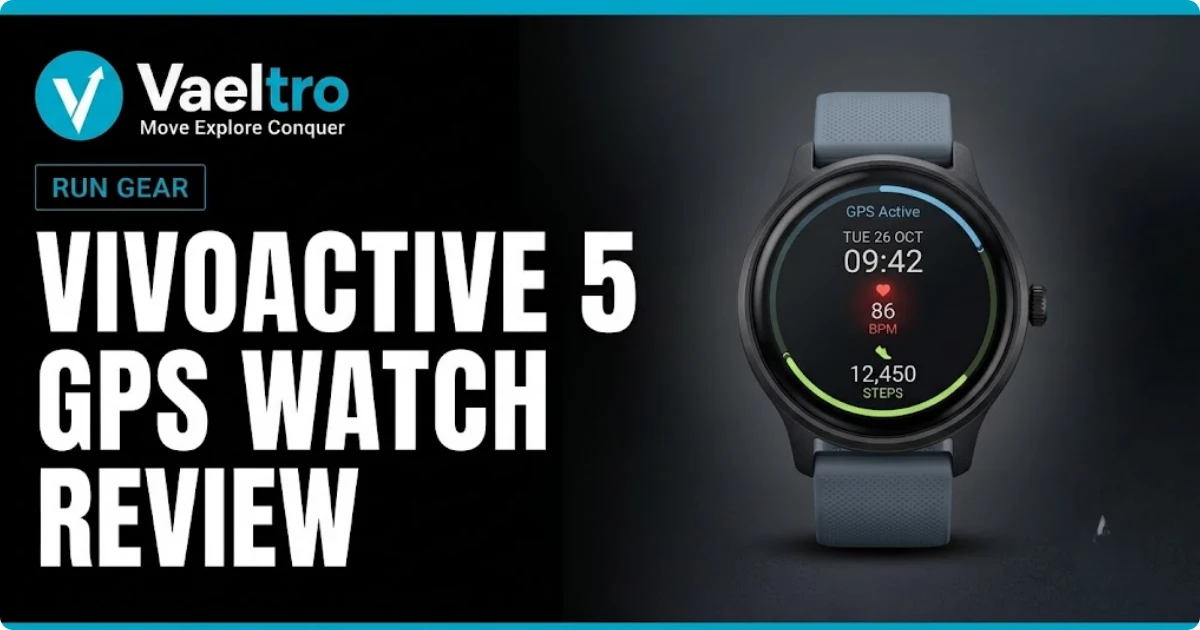
You already know your run stats matter. But so does your heart rate during sleep, your stress at 2 p.m., and whether you’ve recovered enough to lace up tomorrow. That’s the argument Garmin is making with the Vivoactive 5 a GPS watch that covers fitness tracking, daily wellness, and looks decent enough to wear off the trail.
The question is whether it actually delivers or spreads itself too thin. Serious runners may want more from a GPS watch. Casual walkers may not need everything it offers. And at its price point, it has real competition from both Garmin’s own lineup and Fitbit.
This review covers everything that matters running accuracy, health tracking, battery life, waterproofing, and how it compares to the newer Vivoactive 6 and the Venu 3 so you can decide if it belongs on your wrist.
Quick Answer
The Garmin Vivoactive 5 is a strong everyday GPS watch for runners and walkers who want reliable activity tracking, solid health monitoring, and long battery life in a sleek package. It is not the right choice for advanced runners who need altimeter data, structured training plans, or detailed performance metrics.
What Is the Garmin Vivoactive 5?
Garmin released the Vivoactive 5 in September 2023 as the follow-up to the Vivoactive 4. It sits in Garmin’s mid-range lifestyle fitness category above entry-level trackers but below the Forerunner and Fenix training-focused lines.
The target buyer is someone who runs a few times a week, walks daily, and wants a watch that tracks workouts and health without feeling like gear. It ships with over 30 built-in sport modes, a bright AMOLED touchscreen, Garmin Pay, onboard music storage, and the full Garmin Connect wellness ecosystem.
The retail price at launch was $299.99 in the US and £269.99 in the UK, though street prices have softened since then. It comes in a single 42mm case size in multiple color options.
Design and Display
Build Quality and Comfort
The Vivoactive 5 has a slim, round profile that leans lifestyle over sport. The case is made from reinforced polymer with a stainless steel bezel, keeping it light around 39 grams without the band. On the wrist, it sits flat and doesn’t snag on sleeves.
The silicone band that ships in the box is soft and flexible, which makes it comfortable for all-day wear including during sleep tracking. The band uses a standard 20mm lug width, so aftermarket options are easy to find.
There is one physical button on the right side, with navigation handled almost entirely via the touchscreen. This works well for daily use but can be frustrating mid-run with sweaty hands or gloves. Button navigation during workouts would have been more practical.
AMOLED Display
The 1.2-inch AMOLED display is one of the watch’s strongest features. Colors are vivid, blacks are deep, and it’s noticeably sharper than the MIP transflective screens on older Garmin models. Outdoor readability is good in most conditions, though direct harsh sunlight can wash it out more than a MIP display would.
The always-on display mode is available but cuts battery life significantly. Most users will want to keep it in gesture-to-wake mode for daily wear.
GPS and Tracking Accuracy
The Vivoactive 5 uses a multi-band GPS system supporting GPS, GLONASS, and Galileo. In open environments with clear sky visibility, GPS tracking is reliable and route maps look clean in Garmin Connect.
Under tree cover or in urban canyons with tall buildings, occasional drift does appear. This is not unique to the Vivoactive 5 most watches at this price point show some deviation in challenging GPS conditions but runners who frequently train in dense tree cover or city centers may notice it.
Heart rate accuracy during steady-paced activities like walking and easy running is generally solid. Accuracy can drop during high-intensity intervals or fast tempo efforts, which is a common limitation of wrist-based optical heart rate sensors across all brands.
The Vivoactive 5 does not have a barometric altimeter. This means elevation data relies entirely on GPS, which is less accurate than a dedicated altimeter. For flat-road runners and walkers, this rarely matters. For trail runners or hikers tracking elevation gain, it is a meaningful omission.
Running and Walking Features
Sport Modes and Activity Tracking
The Vivoactive 5 covers over 30 built-in sport modes. For runners, the key ones include outdoor running, indoor treadmill running, trail running, and race tracking. Walking modes cover outdoor walk and indoor walk.
During outdoor runs, it records the standard metrics: pace, distance, heart rate, cadence, and elapsed time. Post-run summaries in Garmin Connect are clear and include a map, lap splits, and heart rate zone breakdown.
The treadmill mode uses the wrist accelerometer to estimate pace and distance when GPS is not available. These estimates are reasonably accurate at consistent paces but can drift during varied speed work or very slow walking.
Garmin Connect syncs run data well and the app interface is one of the cleaner fitness platforms available. Long-term training history is easy to review, and the app integrates with Strava without issues.
What the Vivoactive 5 Lacks for Serious Runners
Runners who train with structure will notice some gaps. The Vivoactive 5 does not offer Garmin Coach training plans, VO2 Max estimates with training load feedback, running dynamics (ground contact time, vertical oscillation), or recovery advisor recommendations based on workout effort.
These features live in the Forerunner 265 and 965 watches designed specifically around running performance. If you follow a training plan, track lactate threshold, or race seriously, those watches are the better fit. The Vivoactive 5 is built for the runner who wants to track their runs well, not analyze them in depth.
Health and Wellness Tracking
Sleep Tracking and Body Battery
Sleep tracking is one of the Vivoactive 5’s standout capabilities. It records sleep stages light, deep, and REM along with sleep duration and overnight heart rate variability. The Sleep Score feature gives a single number each morning with a short summary of what affected it.
Garmin’s nap detection is also included, which automatically logs naps taken during the day. It is a small feature that adds genuine value for users who track recovery holistically.
Body Battery is Garmin’s energy-level metric, calculated from HRV, stress data, sleep quality, and activity. It runs on a 0–100 scale throughout the day. Many users find it a useful early signal of under-recovery, though it should be treated as a directional guide rather than a precise measurement.
Heart Rate and HRV Monitoring
The Elevate Gen 5 optical heart rate sensor runs continuously during the day and night. Resting heart rate, heart rate variability, and stress readings are all logged automatically.
HRV Status is included, which tracks your 5-week baseline and flags significant deviations. For users who want to understand daily readiness without manually interpreting raw HRV numbers, this makes the data approachable.
Pulse Ox, which estimates blood oxygen saturation, is available but is positioned as a wellness indicator rather than a clinical measurement.
Is the Garmin Vivoactive 5 Waterproof?
The Garmin Vivoactive 5 carries a 5 ATM water resistance rating. This means it is water-resistant to 50 meters and rated for swimming, showering, and recreational water activities.
It has a dedicated swimming mode that tracks laps, stroke type, SWOLF score, and distance in the pool. Open water swimming is also supported as a separate activity mode.
It is not rated for scuba diving or high-velocity water sports. For everyday use including swim sessions, showering, and rain the 5 ATM rating is more than sufficient.
The touchscreen continues to function reasonably well in water, though pool water can occasionally trigger unintended taps during lap swims. Using the physical button to start and pause swim workouts is more reliable.
Battery Life
| Mode | Battery Life |
|---|---|
| Smartwatch Mode (AOD off) | Up to 11 days |
| Smartwatch Mode (AOD on) | Up to 8 days |
| GPS Only Mode | Up to 19 hours |
| Multi-Band GPS Mode | Up to 15 hours |
| Real-World (daily use + 30–60 min GPS) | 8–10 days |
| Charge Time (0–100%) | ~90 minutes |
Garmin rates the Vivoactive 5 at up to 11 days in smartwatch mode with the always-on display turned off. With GPS active, battery life drops to approximately 19 hours in GPS-only mode and around 15 hours with multi-band GPS.
In real-world use, most runners report 8–10 days between charges with daily activity tracking, sleep monitoring, and 30–60 minutes of GPS activity per day. This is a practical improvement over the Vivoactive 4 and competitive for this price range.
The always-on display mode reduces smartwatch battery life to around 8 days. Users who prioritize battery longevity should keep gesture-to-wake enabled.
Charging uses Garmin’s proprietary clip connector, which is the same used across most modern Garmin devices. It charges from near-empty to full in roughly 90 minutes.
Garmin Vivoactive 5 vs Venu 3
| Feature | Garmin Vivoactive 5 | Garmin Venu 3 |
|---|---|---|
| Case Size | 42mm | 41mm / 45mm |
| Display | 1.2″ AMOLED | 1.4″ AMOLED (45mm) |
| Weight (without band) | ~39g | ~47g |
| Water Resistance | 5 ATM | 5 ATM |
| Battery (Smartwatch Mode) | Up to 11 days | Up to 14 days |
| Wheelchair Profiles | No | Yes |
| Launch Price (US) | $299.99 | $449.99 |
| Launch Price (UK) | £269.99 | £399.99 |
The Venu 3 is the natural comparison point within Garmin’s own lineup. It shares the AMOLED display, the 5 ATM waterproofing, and the Garmin Connect wellness ecosystem. The Venu 3 adds wheelchair activity profiles, a slightly larger 45mm case option, and a more refined fitness age feature.
The Vivoactive 5 is lighter and slimmer. The Venu 3 has a more premium feel but at a higher retail price typically $449.99 at launch.
For most runners and walkers, the Vivoactive 5 covers the same functional ground at a lower cost. The Venu 3 makes more sense if you want the larger screen, the wheelchair profiles, or you simply prefer the build quality difference.
Garmin Vivoactive 5 vs Vivoactive 6
Garmin released the Vivoactive 6 in 2025. It brings a brighter display, improved GPS accuracy with better multi-band performance, an updated sensor package, and some additional health features.
If you are buying new today and the Vivoactive 6 is available at a similar price point, it is the stronger long-term purchase. If the Vivoactive 5 is on sale or available at a meaningful discount, it remains a capable watch that covers all the core features most everyday runners and walkers actually use.
The Vivoactive 5 still makes sense as a buy in 2025 if the price difference is significant, particularly for buyers who are stepping up from a basic fitness band and don’t need the absolute latest hardware
Is the Garmin Vivoactive 5 Worth Buying?
For the right buyer, yes. The Vivoactive 5 delivers a genuinely well-rounded package: reliable GPS, accurate daily health tracking, strong sleep monitoring, legitimate swim capability, and battery life that holds up to everyday use without daily charging.
It earns a clear recommendation for runners who log 3–5 runs per week and want a watch that handles fitness and health in one device. It is equally well suited to walkers who track daily steps, zones, and recovery.
It is not the right watch if you follow structured training plans, race competitively, or need elevation data from a barometric altimeter. In those cases, the Forerunner 265 is a more purposeful choice.
Compared to Fitbit’s mid-range options, the Vivoactive 5 offers deeper data, better GPS, and a more capable sport tracking system. Fitbit has the edge in simplicity and platform familiarity for users coming from that ecosystem
Final Verdict
The Garmin Vivoactive 5 is one of the most complete everyday GPS watches in its price range. It tracks running and walking well, monitors health and recovery thoughtfully, and lasts long enough between charges to stop thinking about it. The AMOLED display is sharp, the swim tracking is genuine, and the Garmin Connect platform gives the data real meaning over time.
Its limits are real no altimeter, no advanced training metrics, limited performance coaching but those limits only matter if you need them. For casual to moderate runners, daily walkers, and health-focused buyers who want one device that does most things well, the Vivoactive 5 is a smart, practical choice that holds up beyond the first few weeks of ownership.
